
How to Plate Titanium: Aerospace-Grade Surface Prep
Titanium forms one of the most stubborn oxide layers of any metal. Learn the aggressive chemical activation and nickel-strike techniques required to successfully electroplate titanium for aerospace and medical applications.
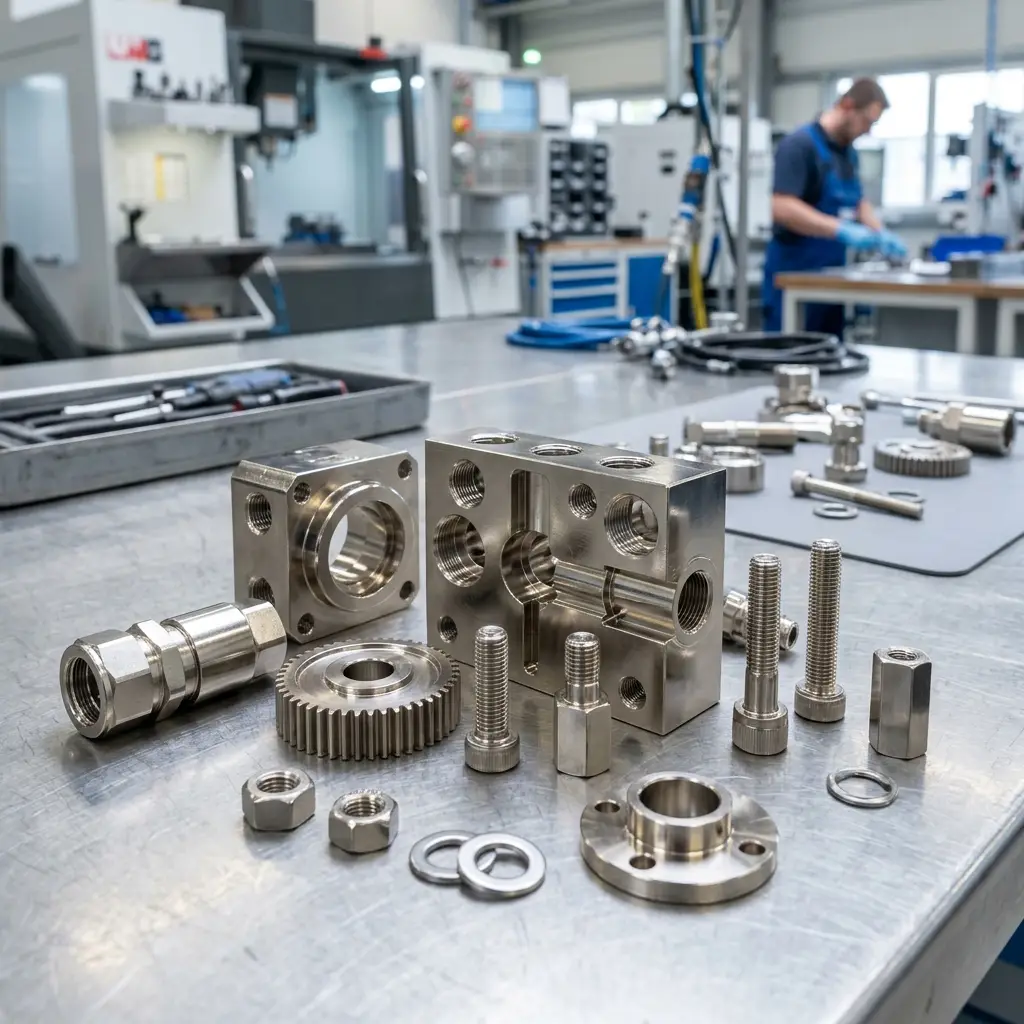
Titanium is the darling of the aerospace and medical device industries. It offers an incredible strength-to-weight ratio, high-temperature stability, and exceptional biocompatibility.
However, titanium has two major engineering flaws:
- Galling: Titanium parts cold-weld (seize) together almost instantly under sliding pressure. You cannot thread a titanium bolt into a titanium nut without it locking up permanently.
- Poor Solderability/Brazing: You cannot wet solder or brazing filler to raw titanium.
To solve these problems, titanium must be electroplated—often with Silver (for anti-galling) or Nickel/Gold (for solderability).
But plating titanium is considered one of the most difficult tasks in the surface finishing industry. This guide explains why, and how the aerospace industry achieves it.
The Problem: The Titanium Dioxide Barrier
Titanium’s legendary corrosion resistance comes from its ability to form a passive oxide layer (\textTiO_2) the millisecond it is exposed to oxygen or water.
This oxide layer is far more stubborn and chemically resistant than the chromium oxide layer found on stainless steel. If you attempt to electroplate over this oxide, the plating will immediately flake off.
To achieve an atomic bond, the plater must destroy the \textTiO_2 layer and deposit an active metal layer before the oxide can reform. Because titanium oxidizes instantly in water, standard acid pickles are entirely useless.
The Solution: Aggressive Activation
Successfully plating titanium requires a highly specialized, multi-step pre-treatment process that utilizes some of the most aggressive chemicals in the plating shop.
Step 1: Rigorous Descaling and Cleaning
Raw titanium often arrives with a heavy, heat-induced alpha-case or scale from forging.
- Mechanical Blasting: The part is often wet-blasted with fine alumina to physically remove the heavy outer scale.
- Alkaline Cleaning: Heavy-duty, high-temperature soak cleaning to remove all organics.
Step 2: The Hydrofluoric Acid Etch (The Danger Zone)
Standard acids (HCl, \textH_2\textSO_4) cannot touch titanium dioxide. The only acid that effectively dissolves \textTiO_2 is Hydrofluoric Acid (HF).
Hydrofluoric acid is extremely dangerous. It is highly toxic, absorbs through the skin, and actively destroys calcium in human bones. Processing titanium requires highly trained operators, specialized safety gear, and dedicated exhaust systems.
- The part is submerged in a bath containing a mixture of Nitric Acid and Hydrofluoric Acid (\textHNO_3 / HF).
- The HF attacks the oxide and etches the underlying titanium substrate, providing a microscopic mechanical tooth.
- The Nitric acid acts as an oxidizer, helping to control the etch rate and preventing the titanium from absorbing too much hydrogen (which causes embrittlement).
Step 3: The Activation Strike
Even after the HF etch, if you move the part to a standard water rinse, the oxide will immediately reform. The activation must happen in a bath that prevents oxidation.
There are two primary methods used in aerospace to activate and strike titanium:
Method A: The Acid-Fluoride Nickel Strike The part goes into a specialized acidic nickel bath containing fluoride ions. The fluorides continuously dissolve any reforming oxide, while a high electrical current forces a thin layer of nickel to deposit onto the bare titanium.
Method B: The Platinum / Gold Strike Used for ultra-high-reliability applications. The etched titanium is placed into a highly acidic platinum or gold bath. The noble metal is plated directly onto the titanium, creating a perfectly active, oxidation-proof barrier layer.
The Final Finish: Electroplating the Titanium
Once the titanium is completely sealed with a highly adherent Nickel, Platinum, or Gold strike layer, it behaves like any normal metal. It can now be transferred to standard plating lines.
Common Aerospace Stacks on Titanium:
- Anti-Galling Fasteners: Titanium substrate \rightarrow HF Etch \rightarrow Nickel Strike \rightarrow Silver Plate (5 - 10 \text µm). The silver acts as a high-temperature solid lubricant, allowing titanium threads to be torqued and untorqued without seizing.
- Brazing / Soldering Assemblies: Titanium substrate \rightarrow HF Etch \rightarrow Nickel Strike \rightarrow Electroless Nickel (ENP) or Matte Tin. This allows complex titanium housings to be hermetically sealed or soldered to copper electronics.
- Wear Resistance: Titanium substrate \rightarrow HF Etch \rightarrow Nickel Strike \rightarrow Hard Chrome. Applied to titanium actuator shafts to provide a hardened wear surface while maintaining the low weight of the titanium core.
Design Considerations for Engineers
- Avoid Blind Holes: The viscous HF/Nitric etch solutions are very difficult to rinse out of deep blind holes. If HF is trapped in a hole, it will continue to eat the titanium from the inside out, leading to catastrophic failure. Design flow-through holes whenever possible.
- Hydrogen Embrittlement: Titanium alloys (like Ti-6Al-4V) are highly susceptible to hydrogen embrittlement during the etching and plating process. Specifications often require immediate post-plate baking (e.g., 190°\textC for 12 hours) to outgas any absorbed hydrogen.
- Cost: Because of the hazardous chemicals (HF), the required safety protocols, and the complexity of the strike baths, plating titanium is significantly more expensive than plating steel or aluminum.
Plating titanium is not for the faint of heart. It requires uncompromising chemical control and safety infrastructure. If your aerospace or medical assemblies require plated titanium, contact Platinex Industries to discuss our exotic alloy processing capabilities.