
Hard Coat Anodizing (Type III): Engineering-Grade Surface Hardness
Explore the extreme wear resistance of MIL-A-8625 Type III Hard Coat Anodizing. Learn why it is processed near freezing temperatures, how it affects part dimensions, and when to specify it over standard anodizing or hard chrome.
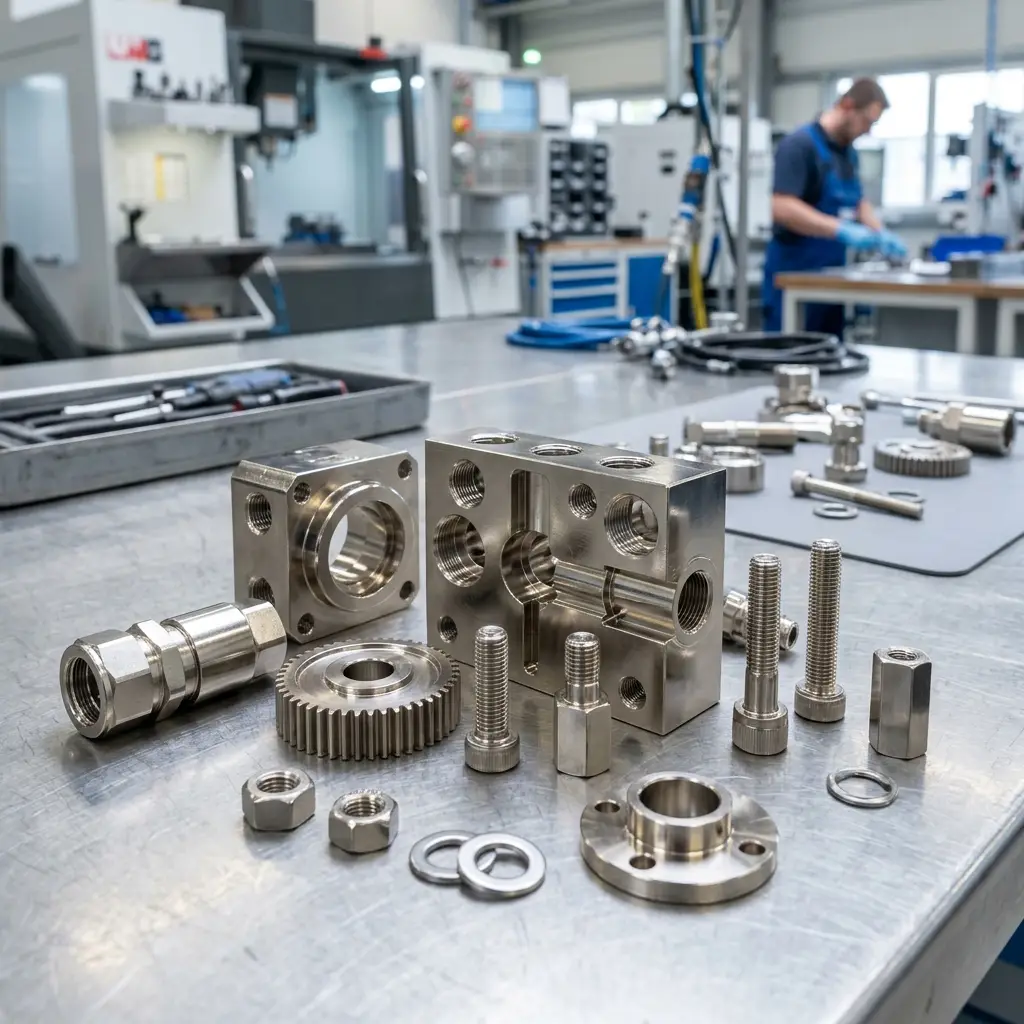
When an engineer needs to make a lightweight aluminum component behave like hardened steel, they specify Type III Hard Coat Anodizing.
Standard (Type II) anodizing is excellent for corrosion protection and decorative coloring. However, when the component is a pneumatic cylinder, a gear, a high-speed pulley, or a firearm receiver, standard anodizing will quickly wear away under mechanical abrasion.
Hard Coat Anodizing, defined by the military specification MIL-A-8625 Type III, produces an aluminum oxide layer that is dramatically thicker, denser, and harder than standard anodizing.
This guide details the unique manufacturing process required to create this super-hard ceramic layer and the critical design rules engineers must follow when specifying it.
How Type III Differs from Type II
While both processes use a sulfuric acid bath to electrochemically convert the aluminum surface into aluminum oxide (\textAl_2\textO_3), the operating conditions for Hard Coat are extreme.
1. Near-Freezing Bath Temperatures
The key to creating a thick, dense oxide layer is preventing the sulfuric acid from dissolving the newly formed oxide while the current continues to build it deeper.
- Type II (Standard): Operates at room temperature (approx. 20°\textC). The acid slowly dissolves the outer pores, limiting the maximum thickness.
- Type III (Hard Coat): Operates at near-freezing temperatures (typically 0°\textC to 5°\textC). The extreme cold dramatically slows the dissolution rate of the oxide, allowing the coating to build to immense thicknesses without crumbling. This requires massive, energy-intensive industrial chillers.
2. High Voltages and Current Densities
Because the cold bath increases the electrical resistance of the oxide layer, much higher voltages (up to 100V, compared to 15-20V for standard anodizing) and higher current densities are required to force the process to continue.
The Properties of Hard Coat Anodizing
Exceptional Hardness
The aluminum oxide created during Hard Coat anodizing is essentially a microscopic layer of sapphire.
- Microhardness: The coating typically measures between 500 and 850 HV (Vickers Hardness), equivalent to 50-65 HRC on the Rockwell C scale. It is file-hard and highly resistant to abrasive wear.
Impressive Thickness
- While Type II tops out around 25 \text µm (0.001”), Type III Hard Coat is routinely specified at 50 \text µm (0.002”), and can be pushed to 100+ \text µm for specific salvage or high-wear applications.
Dielectric Strength (Electrical Insulation)
Aluminum oxide is an excellent electrical insulator. A 50 \text µm Hard Coat layer can withstand breakdown voltages of 800 to 1,200 volts, making it highly valuable in electronics cooling and structural isolation applications.
Color and Aesthetics
Hard Coat is generally not dyed. Due to the extreme density and thickness of the coating, the pores are very small and do not readily accept dye. Furthermore, the thick oxide layer takes on a natural dark color depending on the alloy:
- 6000 Series: Produces a dark grey/charcoal finish.
- 7000 Series: Produces a very dark grey to olive/brown finish. If a black finish is absolutely required, it can be dyed, but the color will not be as vibrant or consistent as a standard Type II dyed part.
Crucial Design Considerations for Engineers
Specifying Hard Coat Anodizing is not as simple as adding a note to a drawing. Because the coating is thick and extremely hard, it significantly alters the geometry of the part.
1. The 50/50 Growth Rule
Anodizing grows the coating outward from the original surface and inward into the substrate equally.
- If you specify a 50 \text µm (0.002”) coating, the part’s dimension will grow by 25 \text µm (0.001”) per surface.
- For a Shaft: The total diameter increases by 50 \text µm (0.002”).
- For a Hole: The total internal diameter decreases by 50 \text µm (0.002”). You must machine your parts undersize or oversize prior to anodizing to account for this growth if tight final tolerances are required.
2. Thread Masking vs. Pitch Diameter
Hard Coating threads is notoriously difficult. A 50 \text µm coating on a 60° thread form will increase the pitch diameter by roughly 4 times the coating thickness per surface (effectively adding 0.004” to the pitch diameter). This will cause standard nuts/bolts to bind instantly.
- Best Practice: Either tap the holes severely oversize prior to anodizing, or specify that all critical threaded holes must be masked (plugged) to remain bare aluminum during the Hard Coat process.
3. Corner Radii (The Spalling Problem)
Because the oxide layer grows perpendicular to the surface, sharp 90° external corners create a void where the growing planes of oxide meet. This void is brittle and will chip or “spall” off under impact.
- Design Rule: Never specify Hard Coat on sharp external corners. For a standard 50 \text µm coating, internal and external corners must have a minimum radius of 1.0 mm (0.040”). Thicker coatings require larger radii.
Sealing Hard Coat: A Trade-off
In Type II anodizing, sealing (in boiling water or nickel acetate) is mandatory to lock in dyes and provide corrosion resistance. For Type III Hard Coat, sealing is generally avoided.
The hydration process that occurs during sealing softens the outer layer of the aluminum oxide. Therefore, sealing a Hard Coat part will decrease its abrasion resistance by roughly 20%.
- If the primary goal is wear resistance, specify Unsealed.
- If the part will operate in a highly corrosive marine environment and wear is secondary, specify Sealed.
For demanding engineering applications where aluminum must perform like hardened steel, Hard Coat Anodizing is the undisputed solution. Contact the engineering team at Platinex Industries to ensure your tolerances and radii are optimized for the Type III process.