
Automotive Fastener Plating: Zinc, Zinc-Nickel, and Torque Control
Explore the stringent surface finishing requirements for automotive fasteners. Learn why OEMs are shifting from standard Zinc to Zinc-Nickel, and the critical role of silicate sealers in achieving highly specific Coefficient of Friction (CoF) targets.
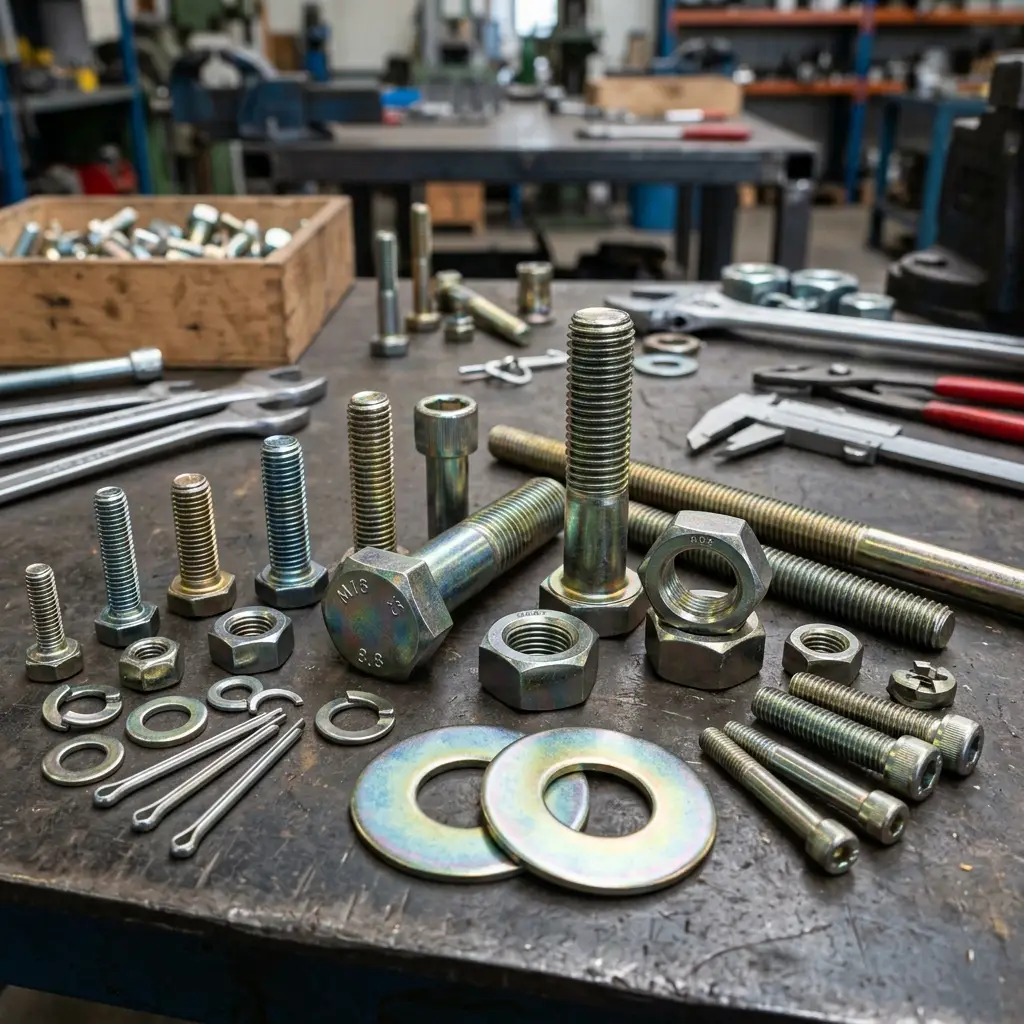
An average passenger vehicle contains over 3,000 fasteners. If the surface finish on those bolts, nuts, and screws fails, the result is not just a cosmetic blemish—it is a catastrophic mechanical failure, leading to massive OEM recalls.
Automotive fastener plating is arguably the most demanding sector of the surface finishing industry. It requires the simultaneous mastery of extreme corrosion resistance, precise dimensional tolerances, hydrogen embrittlement prevention, and mathematically perfect lubricity.
Here is a technical deep dive into the evolution and current standards of automotive fastener plating.
The Shift in Corrosion Standards
For decades, the standard automotive fastener finish was Alkaline Zinc Plating topped with a Hexavalent Yellow Chromate. This provided excellent, self-healing protection that lasted roughly 96 hours to white rust and 240 hours to red rust in a salt spray chamber.
Two factors killed this standard:
- The RoHS Directive: Banned toxic hexavalent chromium, forcing the shift to safer (but initially weaker) Trivalent passivations.
- Extended Warranties: Automakers shifted from 3-year warranties to 7-year or 10-year anti-corrosion warranties. 240 hours of salt spray survival was no longer acceptable for underbody components exposed to harsh winter road salts.
The New Standard: Zinc-Nickel (12-15% Ni)
To meet the demand for 720 to 1,000+ hours of red rust resistance, global OEMs (Ford, VW, Toyota) transitioned their high-exposure fasteners to Zinc-Nickel Alloy Plating.
- Plated from alkaline baths, the 12-15% nickel content dramatically slows the galvanic sacrifice of the zinc.
- It maintains high corrosion resistance even when exposed to engine compartment heat (up to 250°\textC), whereas standard zinc passivations break down at 120°\textC.
- It provides excellent galvanic compatibility with aluminum, preventing rapid corrosion when a steel bolt is driven into an aluminum engine block.
The Most Critical Spec: Coefficient of Friction (CoF)
While corrosion resistance gets the headlines, the most critical requirement for an automotive fastener is its Torque-Tension relationship, governed by its Coefficient of Friction (CoF, or \mu).
Modern automotive assembly lines use highly calibrated robotic torque guns. When the robot applies exactly 100 Nm of torque to a bolt, the engineers expect that torque to generate a very specific amount of “clamp load” (the tension holding the two parts together).
If the surface of the bolt is too rough (high friction), all the torque energy is wasted overcoming friction, and the clamp load will be dangerously loose. If the surface is too slippery (low friction), the bolt will spin too easily, over-stretch, and snap off.
Managing CoF with Sealers and Topcoats
Standard zinc plating with a trivalent passivation has an unpredictable and generally high coefficient of friction. To control this, platers apply specialized silicate sealers or organic topcoats containing lubricants like PTFE (Teflon) or specialized waxes immediately after the passivation layer.
An automotive drawing will specifically call out a required friction window, such as: \mu_tot = 0.12 - 0.18
The plater must select a specific sealer chemistry that guarantees the CoF falls exactly within that 0.06 window. To prove this, lots are routinely tested on torque-tension testing machines (like a Schatz machine) before shipment.
Embrittlement and Dimensional Control
Hydrogen Embrittlement
Many structural automotive fasteners are Grade 10.9 or 12.9 high-strength steel. As discussed in our dedicated embrittlement guide, these parts must be baked at 190°\textC within 4 hours of plating. For Grade 12.9 fasteners where the embrittlement risk is deemed too severe, OEMs often forbid electroplating entirely, specifying non-electrolytic Zinc Flake Coatings (like Geomet or Dacromet) instead.
Dimensional Tolerances (Thread Fit)
Automotive threads (e.g., M8x1.25) have strict pitch diameter tolerances.
- A standard zinc or zinc-nickel plating specification typically calls for an 8 \text µm minimum thickness.
- Because plating builds up on the 60° angles of the thread form, 8 \text µm of plating will increase the pitch diameter by roughly 32 \text µm.
- Platers must tightly control their barrel plating times and bath efficiencies. Over-plating by just 5 \text µm will cause the bolt to jam in the Go/No-Go thread gauge, resulting in a rejected lot.
Platinex Industries operates high-volume, automated barrel lines dedicated to automotive fasteners. We utilize advanced Zinc and Zinc-Nickel chemistries paired with precision torque-control sealers to meet stringent OEM specifications. Contact our quality team to review your automotive finishing requirements.