
Surface Finishing for Pumps and Valves: ENP and Hard Chrome
Industrial pumps and fluid control valves operate in punishing environments. Discover why High-Phosphorus Electroless Nickel and Hard Chrome are the dominant surface finishes for preventing cavitation, wear, and chemical attack.
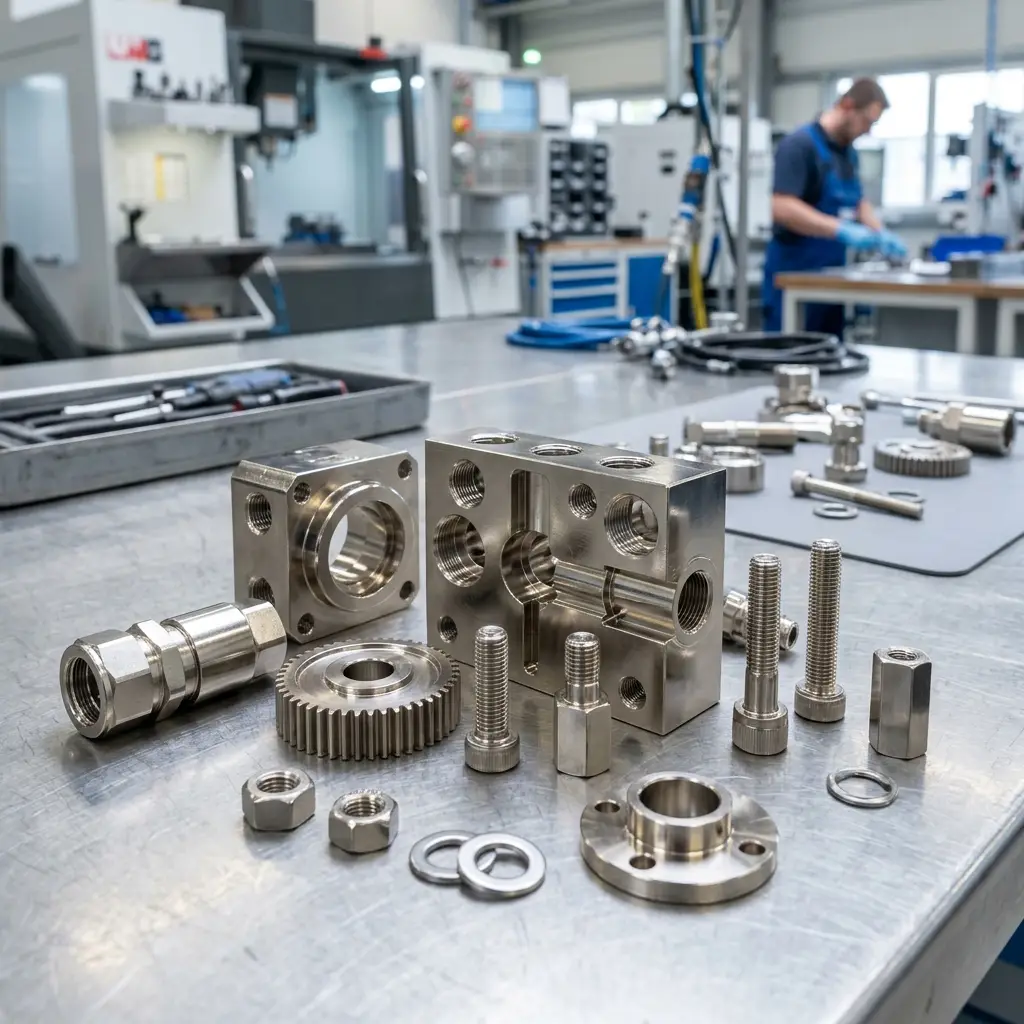
Industrial fluid handling equipment—centrifugal pumps, gate valves, ball valves, and hydraulic cylinders—operate in the most brutal mechanical and chemical environments imaginable.
A steel pump impeller moving drilling mud or acidic wastewater faces a triple threat:
- Chemical Corrosion from the fluid itself.
- Abrasive Wear from suspended particulates (sand, grit).
- Cavitation Damage, where microscopic vapor bubbles collapse with immense force, literally tearing chunks of metal out of the impeller surface.
To survive these conditions, the base metal (often cast iron or mild steel) must be armored. The two undisputed champions of fluid handling protection are Electroless Nickel Plating (ENP) and Industrial Hard Chrome.
1. High-Phosphorus Electroless Nickel (ENP)
For complex fluid handling components like multi-stage impellers, pump housings, and intricately machined valve bodies, ENP is the gold standard.
The Chemistry of Protection
Unlike electroplating, ENP is an autocatalytic chemical process. For pump applications, High-Phosphorus ENP (10% - 14% Phos) is almost exclusively specified.
- The high phosphorus content creates an amorphous (glass-like) metallic structure. Because there are no crystalline grain boundaries for corrosive chemicals to seep into, High-Phos ENP acts as an impenetrable barrier to \textH_2\textS, chlorides, and acidic slurries.
- It is heavily utilized in the Oil & Gas industry (e.g., downhole valves) and marine environments.
The Advantage of Perfect Uniformity
An impeller is a nightmare to electroplate. It has deep internal volutes, sharp outer edges, and blind cavities. If you attempted to electroplate it, the outer edges would build up massive amounts of metal, while the internal fluid paths would receive nothing (poor throwing power). ENP requires no electricity. The nickel-phosphorus alloy deposits at the exact same rate on every surface touched by the fluid. This perfect uniformity ensures tight hydraulic tolerances are maintained without any post-plate machining.
Hardness and Heat Treatment
As-plated, High-Phos ENP is moderately hard (approx. 40-45 HRC) and provides decent wear resistance against suspended particulates. If extreme wear resistance is required, the ENP can be baked at 400°\textC to crystallize the matrix, pushing the hardness to nearly 70 HRC. (Note: This heat treatment significantly reduces the chemical corrosion resistance, so engineers must choose between maximum wear or maximum chemical protection).
2. Industrial Hard Chrome
When the primary mechanism of failure is extreme mechanical abrasion or sliding friction (such as hydraulic cylinder rods, valve stems, and bearing journals), Hard Chrome is specified.
The Physics of Hard Chrome
Hard chrome (plated from a hexavalent chromic acid bath) is not the decorative chrome found on a car bumper. It is plated heavily (often 50 \text µm to 250+ \text µm) directly onto the steel substrate.
- Extreme Hardness: Hard chrome typically measures between 65 and 70 HRC (850 - 1000 \text HV). It is highly resistant to scratching, galling, and abrasive wear from sand or grit in the fluid stream.
- Low Coefficient of Friction: Hard chrome has a naturally slippery surface. When a chrome-plated valve stem passes through a rubber or PTFE packing seal, it causes minimal wear to the seal, preventing fluid leaks and reducing actuation torque.
- Micro-Cracking (Lubricant Retention): The extreme internal stress of hard chrome causes it to develop a microscopic network of cracks during plating. In fluid power applications, these microscopic cracks act as reservoirs, holding hydraulic fluid and ensuring constant lubrication at the seal interface.
The Disadvantages for Pumps
Hard chrome has terrible throwing power. It cannot be plated onto the complex internal surfaces of a pump housing or a multi-vane impeller. Furthermore, because of the micro-cracking, it is not a perfect corrosion barrier on its own; highly corrosive fluids can penetrate the cracks and attack the steel substrate. (This is why hydraulic rods are often plated with a Duplex system: Electroless Nickel followed by Hard Chrome).
The Economics of Plating vs. Exotic Alloys
Why electroplate a mild steel valve body when you could simply manufacture the entire valve out of 316 Stainless Steel, Monel, or Titanium?
The answer is cost and manufacturability.
- Exotic alloys are incredibly expensive raw materials.
- They are notoriously difficult and slow to machine, rapidly burning through cutting tools.
- A heavy cast iron or mild steel valve body can be cast cheaply, machined rapidly, and then plated with 50 \text µm of High-Phos ENP.
The resulting component possesses the mechanical strength and low cost of steel, with the surface chemical resistance of a premium exotic alloy.
At Platinex Industries, we understand the punishing demands of fluid dynamics. We specialize in precision High-Phosphorus Electroless Nickel plating for complex geometries, ensuring your impellers and valves survive their intended lifespan. Contact our engineering team to discuss your fluid handling specifications.