
Rack Plating vs Barrel Plating: Choosing the Right Method
A comprehensive comparison between rack and barrel electroplating. Learn the technical differences, pros and cons, cost implications, and how to choose the right method based on part geometry, size, and tolerance requirements.
When requesting a quote for electroplating, one of the first decisions a surface finishing facility will make is whether your parts will be processed on a rack or in a barrel. This decision dictates the cost, the lead time, the quality of the finish, and the dimensional tolerances that can be achieved.
For procurement professionals and design engineers, understanding the difference between rack and barrel plating—and when to specify each—is crucial for optimizing part design and managing manufacturing costs.
The Barrel Plating Process
In barrel plating, parts are loaded in bulk into a perforated plastic cylinder (the barrel). The barrel is submerged in the plating bath and rotated slowly. Inside the barrel, flexible metal contacts (danglers) touch the tumbling mass of parts, transmitting the electrical current.
How it Works
The parts themselves act as the electrical circuit. As they tumble, different parts are exposed to the outside of the mass (where plating occurs most rapidly) and then pushed to the inside (where plating slows or stops). Over the plating cycle, this tumbling action ensures that all parts receive an average uniform coating.
Advantages of Barrel Plating
- High Volume & Low Cost: The ultimate solution for high-volume, small parts. Loading 10,000 screws into a barrel takes minutes. Hanging them individually on a rack would take hours.
- Labor Efficiency: Requires minimal manual labor per part, drastically reducing the cost per unit.
- Burnishing Effect: The continuous tumbling creates a mechanical burnishing action, often resulting in a smoother, brighter finish than rack plating.
Limitations
- Part Damage: Heavy, fragile, or precision-machined parts can dent, scratch, or deform each other as they tumble.
- Tolerances: Thickness variation from part to part within a batch is higher than in rack plating. Precise thickness control (e.g., ± 2 µm) is difficult.
- Nesting and Tangling: Flat parts (like washers) can stick together (nest), and wire forms can tangle, preventing plating solution from reaching the surfaces.
The Rack Plating Process
In rack plating, parts are individually fixtured (hung) on a custom-designed metal frame coated with heavy insulation, leaving only the contact points exposed. The entire rack is then submerged in the plating bath.
How it Works
Because the parts are held stationary in a fixed orientation relative to the anodes, the current distribution—and therefore the plating thickness—can be tightly controlled.
Advantages of Rack Plating
- Precision and Control: Offers superior control over plating thickness and distribution. High-tolerance components demand rack plating.
- No Mechanical Damage: Because parts do not touch each other, delicate threads, polished surfaces, and fragile geometries are protected.
- Large and Heavy Parts: The only option for parts that are too large or too heavy to tumble in a barrel.
- Selective Plating: Parts can be masked or oriented so that only specific areas receive plating.
Limitations
- High Labor Cost: Every single part must be manually attached to and removed from the rack.
- Tooling Costs: Requires custom or dedicated racking fixtures designed specifically for the part geometry.
- Rack Marks: The point where the part touches the rack contact will not receive plating. Engineers must specify allowable “rack mark” locations on non-critical surfaces.
The Decision Matrix: How to Choose
Use this framework to determine the appropriate plating method for your components:
| Factor | Choose Barrel Plating | Choose Rack Plating |
|---|---|---|
| Part Size & Weight | Small, light (fasteners, clips, small stampings). Generally < 200g. | Large, heavy, or long (shafts, housings, bus bars). |
| Volume | High volume (thousands to millions). | Low to medium volume, or high-value single pieces. |
| Fragility | Robust parts that can withstand tumbling. | Fragile parts, precision threads, polished surfaces. |
| Geometry | Simple geometries. Susceptible to nesting? Reconsider. | Complex geometries, blind holes, parts requiring internal anodes. |
| Thickness Tolerance | Loose tolerances (average batch thickness is acceptable). | Tight tolerances (strict minimum/maximum requirements per part). |
| Cost Sensitivity | High. Cost per part is the primary driver. | Low. Quality and precision justify higher per-part costs. |
Examples in Industry
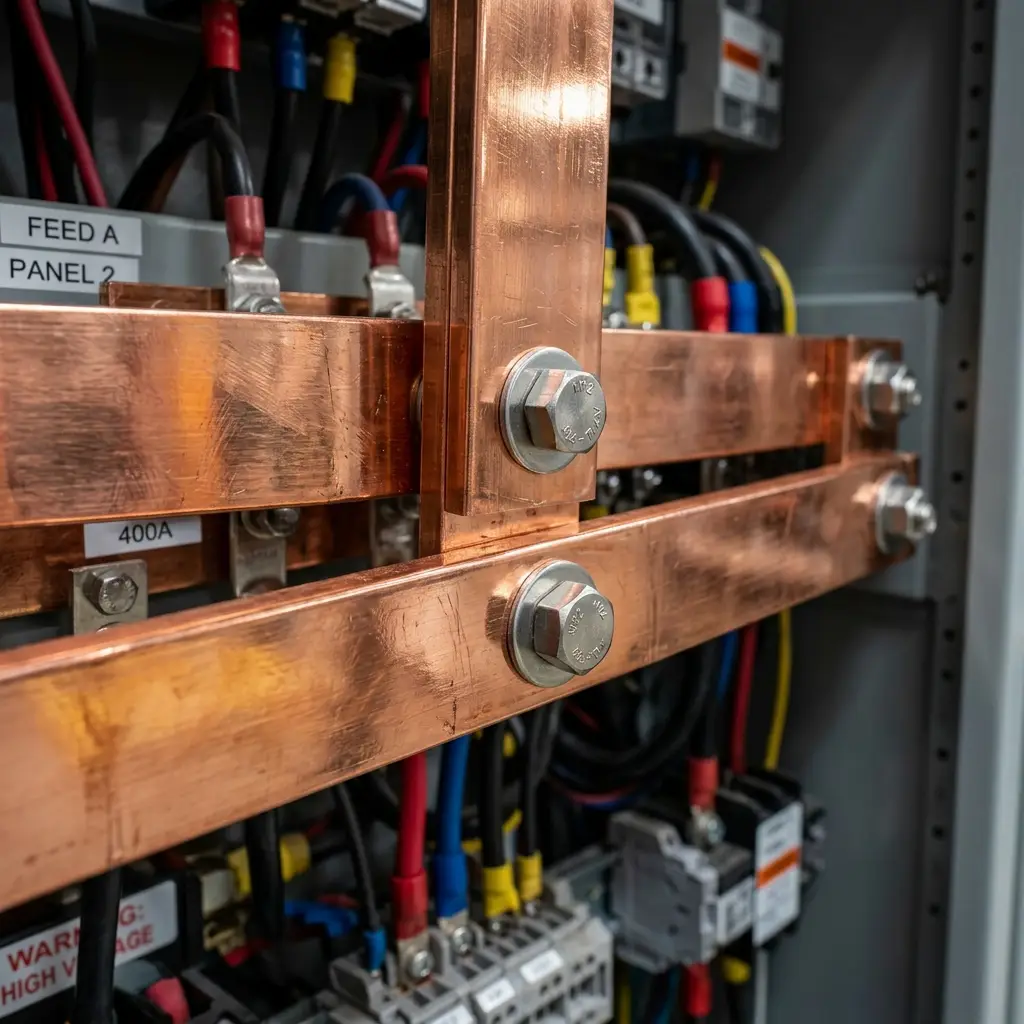
Switchgear Bus Bars: Rack Plating. Copper and aluminium bus bars are heavy, require precise silver or tin thickness at joint interfaces, and must not be scratched. They are exclusively rack plated.
Automotive Fasteners: Barrel Plating. Grade 8.8 bolts require zinc plating for corrosion resistance. The volume is massive, the parts are robust, and tight individual tolerance is less critical than average batch protection.
Precision Electrical Contacts: Rack Plating (or specialized vibratory barrel). Small copper contacts requiring precise gold or silver plating for minimal contact resistance. Tumbling might damage the delicate contact geometry.
Designing for the Plating Process (DfM)
If your goal is to minimize cost by utilizing barrel plating, design your parts accordingly:
- Avoid large flat surfaces that can stick together (nesting).
- Minimize long, thin protrusions that can bend or interlock.
- Accept a wider tolerance band on plating thickness.
If your part requires rack plating, help your plater optimize the process:
- Include a designated tooling hole or non-critical surface where the rack contact can grip the part (the rack mark).
- Avoid deep blind holes, or specify that plating is not required at the bottom of the hole, to prevent trapped chemicals and poor coverage.
At Platinex Industries in Nashik, we operate both high-capacity barrel lines for hardware and fasteners, and precision rack lines for switchgear and custom engineering components. Contact us with your drawing, and our engineers will specify the optimal plating method for your requirements.