
Barrel Plating Explained: How It Works, Its Advantages, and Its Limitations
A complete guide to barrel electroplating — the process that makes bulk plating of small parts economically viable. Covers barrel geometry, current flow physics, loading calculations, and what parts are and are not suitable.
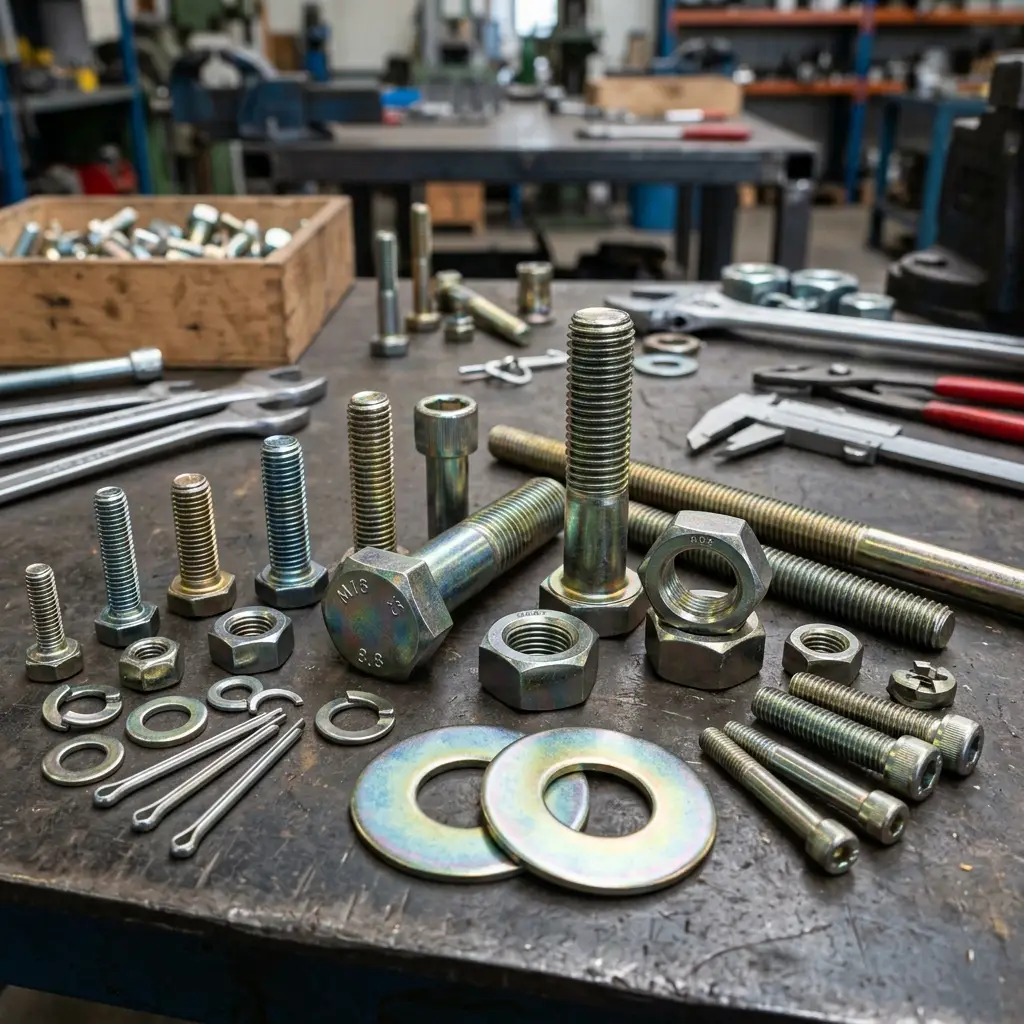
When a fastener manufacturer needs 50,000 bolts zinc-plated by tomorrow morning, they do not hang each bolt individually on a rack and connect it to the plating bus bar. They load them into a barrel — a perforated plastic cylinder that rotates slowly in the plating tank — and let the physics of tumbling and current flow do the work.
Barrel plating is the process that makes industrial-scale electroplating economically feasible for small parts. Understanding how it works, why it produces the results it does, and critically, what types of parts it cannot handle, is essential knowledge for any engineer specifying a surface finish.
How Barrel Plating Works
A barrel plater consists of:
- The barrel: A perforated polypropylene or PVC hexagonal or cylindrical container, typically 200–600mm in diameter, mounted on a shaft so it rotates at 3–8 RPM
- Cathode contacts: Dangler contacts — typically copper or titanium rods with weighted tips — that hang inside the barrel and make electrical contact with the tumbling parts
- Anodes: Suspended outside the barrel in the plating solution, connected to the positive terminal of the rectifier
- Drive motor: Rotates the barrel at a controlled speed
The parts load into the barrel, the barrel submerges in the electrolyte, and rotation begins. As the barrel turns, the parts cascade over each other in a rolling motion. Current flows from the anodes, through the electrolyte, in through the barrel perforations, through the parts touching the cathode danglers, through other parts in the mass (the parts themselves act as part of the electrical circuit), and back to the rectifier.
The Tumbling Electrical Circuit
This is the critical physics to understand. In barrel plating, the parts themselves carry current. The flow path is:
Anode → Electrolyte → Barrel Perforations → Outer Layer Parts → Inner Parts → Dangler Contact → Rectifier Negative
This means:
- Parts must be electrically conductive (or plating will not occur)
- Contact resistance between parts affects current distribution
- Only parts in the outer 20–30% of the barrel mass are actively plating at any instant; inner parts are “resting”
- The tumbling motion continuously rotates parts from the inner mass to the outer active zone
Barrel Design Parameters
| Parameter | Typical Range | Effect on Deposit |
|---|---|---|
| Barrel diameter | 250–600mm | Larger = more parts per load, longer drop height |
| Rotation speed | 3–8 RPM | Slower = more dwell time per rotation, gentler tumbling |
| Load volume | 40–60% full | Under-filled = excessive part-to-part impact; over-filled = poor current distribution |
| Perforation size | 3–8mm holes | Must be large enough for electrolyte flow, small enough to retain parts |
| Dangler count | 2–4 per barrel | More danglers = more uniform current distribution |
What Barrel Plating Does Well
1. High Throughput on Small Parts
A single barrel load of M8 bolts might contain 8,000–12,000 pieces. Rack plating the same quantity would require 30–50 racks with individual hanging of each part. Barrel plating processes that entire quantity simultaneously, with loading and unloading taking minutes rather than hours. For commoditised hardware where cost is the primary driver, barrel plating is the only economically viable approach.
2. Self-Burnishing Effect
The constant tumbling of parts against each other and the barrel walls produces a mild mechanical polishing action. Barrel-plated parts often have a brighter, smoother appearance than identically-plated rack parts because surface micro-asperities are continuously being burnished during the plating cycle.
3. Uniform Average Thickness
Because every part spends time in the “active” outer zone and “resting” inner zone through the rotation cycle, the thickness averages out across the batch. This self-averaging effect means barrel-plated batches have lower part-to-part variation in coating thickness compared to rack plating with poor current distribution control.
What Barrel Plating Cannot Do
1. Complex or Fragile Geometries
If a part can be damaged by tumbling against other parts, it should not be barrel plated. This excludes:
- Parts with precision machined surfaces (threads finer than M4)
- Thin-walled tubes or shells that can dent
- Parts with long, thin projections that will bend
- Parts with sharp edges that will nick other parts
- Electronic components, connectors with contact pins, any assembled subassembly
2. Large or Heavy Parts
Practical barrel capacity is limited. Parts heavier than ~200g per piece tend to cause mechanical damage through part-on-part impact and exceed what the barrel drive motor can tumble effectively. For parts above this weight, rack plating is standard.
3. Consistent Orientation Requirements
Barrel plating cannot control the orientation of individual parts. If the drawing requires plating on a specific face only, or requires masking of a particular feature, barrel plating cannot accommodate this. Selective plating requires rack mounting.
4. Tight Thickness Tolerance Requirements
While barrel plating achieves good batch-average control, the variation within a batch is higher than rack plating. Specifications requiring thickness within ±1 µm across a single part are not achievable in barrel plating — the variation in surface orientation relative to the anode through the tumbling cycle is too high.
Part Suitability Guide
| Part Type | Barrel Suitable? | Notes |
|---|---|---|
| Bolts, nuts, washers (M4–M24) | Yes | Ideal application |
| Small turned parts (< 50mm) | Yes | Check fragility |
| Spring clips, circlips | Yes | Check for entanglement |
| Small stampings (< 150mm) | Usually | Check for nesting/tangling |
| Precision machined parts | Marginal | Consult plater — may damage threads |
| Tube assemblies | No | Risk of denting |
| Electronic components | No | Fragile; contamination risk |
| Parts > 200g each | No | Too heavy for barrel |
| Parts > 150mm longest dimension | No | Too large; rack plate instead |
Loading and Cycle Calculation
One of the most common production planning questions is: how long does a barrel cycle take?
The calculation depends on the required thickness and the current efficiency of the plating system. Using Faraday’s law:
Mass deposited (g) = (Atomic weight × Current × Time × Efficiency) / (Valence × Faraday constant)
For zinc (valence = 2, atomic weight = 65.38 g/mol, typical cathode efficiency = 95%):
To deposit 10 µm of zinc on 10,000 M8 bolts (total surface area ≈ 10 m²) at 2 A/dm² would require:
- Total current = 2 A/dm² × 1,000 dm² = 2,000 A (2 kA)
- Time for 10 µm = approximately 18–22 minutes at this current density
In practice, barrel cathode efficiency is lower than rack plating (85–92% versus 95–98%) because current must pass through multiple part-to-part interfaces, each adding resistance. Barrel plating operations set their current densities and times empirically using Hull Cell tests and production trial runs, then document the recipe (current, time, barrel speed, load weight) in their process sheets.
Barrel vs Rack: The Decision Framework
| Requirement | Choose Barrel | Choose Rack |
|---|---|---|
| Part count | High (> 500 per batch) | Low (< 200 per batch) |
| Part size | Small (< 150mm, < 200g) | Large or heavy |
| Part fragility | Low | Moderate to high |
| Geometry complexity | Simple | Complex (blind holes, precision) |
| Thickness tolerance | ±20–30% acceptable | ±5–10% required |
| Orientation control | Not required | Required (masking, selective) |
| Cost | Lower | Higher |
Frequently Asked Questions
Why do barrel-plated parts sometimes have unplated spots? Unplated spots (skip plating) occur when parts nest together or tangle, preventing electrolyte from reaching the enclosed surfaces. This is most common with ring-shaped parts, flat stampings that stack, and spring clips that interlock. Solutions include reduced barrel loading, addition of non-conductive media (plastic balls) to separate parts, or switching to rack plating.
Can you barrel plate precious metals like gold or silver? Yes, but with important differences. Because precious metal baths are extremely expensive, drag-out (electrolyte carried out by parts when removed) must be minimised. Barrel precious metal plating uses very slow drain cycles and rinse recovery to minimise metal loss. It is economically viable for small gold or silver plated components produced in high volume.
What is the maximum current I can apply to a barrel? Limited by the contact resistance through the parts and the electrolyte capacity to carry current through the barrel perforations. Pushing too high a current causes localised overheating, burnt deposits on the outer parts, and poor coverage on inner parts. Barrel operations rarely exceed 2–3 A/dm² on the bulk surface area.
How do you calculate the surface area for barrel plating? You cannot measure each part’s surface area individually. For standard hardware, use published tables (bolt surface areas by size and length are standardised). For custom parts, calculate the geometric surface area from CAD and add a 15–20% factor for thread and surface features. Your plater’s process engineer will have experience calculating this for similar part types.
Running high-volume barrel plating orders for fasteners, hardware, or small components in Nashik? Contact Platinex for capacity, lead time, and specification discussion.