
ASTM B633: The Complete Guide to Zinc Coating Specifications
A detailed breakdown of ASTM B633, the standard specification for electrodeposited zinc coatings on iron and steel. Learn how to decipher thickness classes, types, and post-plating requirements.
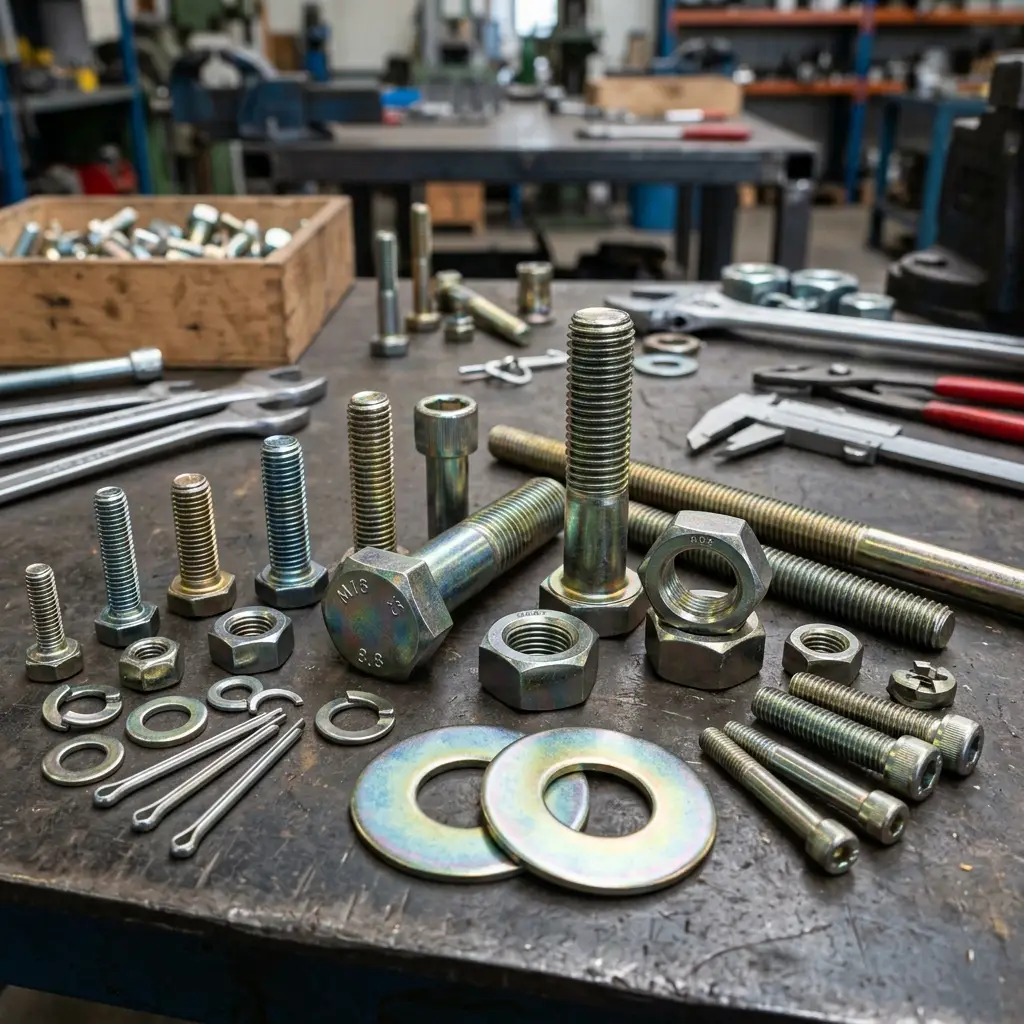
When an engineering drawing calls out “Zinc Plate” without further clarification, it leaves the manufacturer guessing. Will a 3 µm flash coat suffice, or does the part require 25 µm for severe outdoor exposure? Is a clear passivation acceptable, or does it need a yellow chromate? Does it require hydrogen embrittlement relief?
To eliminate this ambiguity, the industry relies on ASTM B633: Standard Specification for Electrodeposited Coatings of Zinc on Iron and Steel.
Understanding how to read and specify ASTM B633 is essential for any engineer designing steel components. A complete and correct ASTM B633 callout dictates the thickness, the supplemental treatment (passivation), and the required testing, ensuring the part performs as expected in its intended environment.
Deciphering the ASTM B633 Callout
A proper ASTM B633 specification on a drawing looks like this:
“Zinc Plate per ASTM B633, Fe/Zn 12, Type II”
Let’s break down what each part of this callout means.
1. The Base Metal and Coating (Fe/Zn)
- Fe: Denotes the substrate (Iron/Steel).
- Zn: Denotes the coating (Zinc).
2. The Thickness Class (12)
The number following “Fe/Zn” indicates the minimum thickness of the zinc coating in micrometers (µm). ASTM B633 defines four standard service condition classes based on the severity of the environment.
| Classification | Minimum Thickness | Service Condition | Typical Applications |
|---|---|---|---|
| Fe/Zn 25 | 25 µm (0.0010 in.) | SC 4: Very Severe | Harsh outdoor exposure, marine environments. |
| Fe/Zn 12 | 12 µm (0.0005 in.) | SC 3: Severe | Outdoor exposure, non-marine. Automotive underbody. |
| Fe/Zn 8 | 8 µm (0.0003 in.) | SC 2: Moderate | Indoor exposure with condensation. Standard hardware. |
| Fe/Zn 5 | 5 µm (0.0002 in.) | SC 1: Mild | Indoor, dry environments. Decorative hardware. |
Note: For threaded fasteners, applying 25 µm of zinc will often interfere with thread fit. For standard metric threads, Fe/Zn 8 is typically the maximum practical thickness unless the threads are explicitly cut undersize prior to plating.
3. The Supplementary Treatment (Type II)
The “Type” designates the post-plating passivation (conversion coating) applied over the zinc. This layer provides the initial barrier against corrosion and dictates the appearance of the part.
| Type | Description | Color/Appearance | Typical Salt Spray to White Rust |
|---|---|---|---|
| Type I | As-plated (No supplementary treatment) | Bright, metallic | < 12 hours |
| Type II | Colored chromate conversion | Yellow, iridescent, olive drab | 96 hours |
| Type III | Colorless chromate conversion | Clear, slight blue/silver tint | 12 hours |
| Type IV | Phosphate conversion | Gray/black (used as a paint base) | Variable |
| Type V | Colorless passivate (RoHS Trivalent) | Clear | > 72 hours |
| Type VI | Colored passivate (RoHS Trivalent) | Iridescent, yellow, black | > 120 hours |
Important Update: Historically, Types II and III relied on Hexavalent Chromium (Cr⁶⁺). Due to RoHS and REACH regulations, Types V and VI were added to explicitly denote Trivalent Chromium (Cr³⁺) passivations. If you require RoHS compliance, you should specify Type V or Type VI.
Hydrogen Embrittlement Relief (Baking)
ASTM B633 includes strict provisions for hydrogen embrittlement relief, referencing ASTM B849 (Pre-Treatments) and ASTM B850 (Post-Treatments).
If your steel component has a tensile strength greater than 1000 MPa (or hardness > 31 HRC / 310 HV), the specification mandates post-plating baking to drive out absorbed hydrogen and prevent delayed brittle fracture.
- The Requirement: Baking at 190°C to 220°C for 3 to 24 hours, depending on the tensile strength.
- The Timing: Baking must commence within 1 to 3 hours after electroplating, and critically, before the application of the supplementary treatment (Types II, III, V, VI), as baking will destroy the chromate/passivate layer.
If your drawing simply says “ASTM B633,” the plater is technically required to bake high-strength parts. However, a best practice is to explicitly state the baking requirement on the drawing: “Bake per ASTM B850 Class ER-1 immediately after plating.”
Required Testing Under ASTM B633
When a lot of parts is certified to ASTM B633, the plating facility is affirming that the parts have passed (or would pass) several standard tests:
- Thickness Testing (ASTM B487, B499, B504, or B568): XRF (X-Ray Fluorescence) or magnetic induction is used to verify the minimum thickness specified by the Class.
- Adhesion Testing (ASTM B571): Typically a burnishing test or bend test. The zinc must not peel, flake, or blister.
- Corrosion Resistance (ASTM B117): Neutral salt spray testing. The parts must resist the formation of white corrosion products (zinc oxide) for the duration specified by the Type (e.g., 96 hours for Type II).
How to Write a Flawless Callout
To ensure you get exactly what you need, leave no room for interpretation. A complete callout should include:
- The standard (ASTM B633)
- The thickness class (e.g., Fe/Zn 12)
- The supplementary treatment type (e.g., Type VI)
- RoHS compliance statement (if required)
- Baking requirement (if material strength dictates it)
Example of a Perfect Callout for an Automotive Bracket:
Finish: Zinc Plate per ASTM B633, Fe/Zn 12, Type VI (Trivalent Yellow Passivate). Must be RoHS Compliant. Post-plate bake at 190°C for 8 hours required per ASTM B850 prior to passivation.
At Platinex Industries, we routinely process orders to strict ASTM B633 specifications, providing XRF thickness reports and Certificates of Compliance. Contact us to ensure your parts meet the standard.