
Plating for Transformers: Copper and Silver Solutions
Power transformers are the heart of the electrical grid. Learn why heavy copper busbars, tap changers, and structural components rely on Tin, Silver, and Zinc plating to prevent catastrophic grid failures.
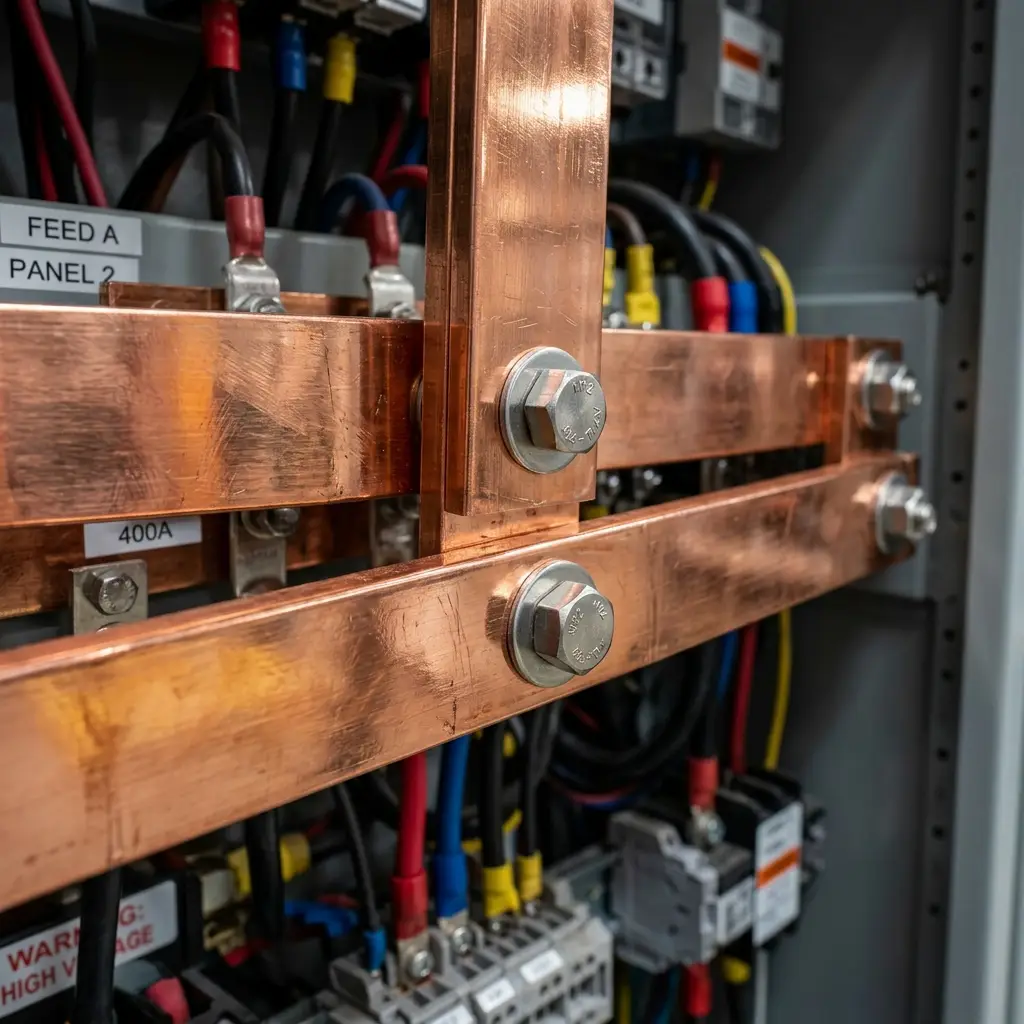
A high-voltage power transformer is one of the most critical and expensive pieces of infrastructure in the modern world. Designed to step up voltage for transmission or step it down for distribution, these massive oil-filled or dry-type machines operate continuously under immense electrical, thermal, and mechanical stress.
A failure inside a substation transformer doesn’t just mean a localized blackout; it can result in catastrophic explosions, oil fires, and millions of dollars in damages.
To ensure decades of reliable operation, every metallic component inside and outside a transformer—from the massive primary buswork to the delicate tap changer contacts—is heavily engineered and specifically electroplated.
1. Internal Buswork and Terminations: Matte Tin Plating
Inside a transformer, massive copper busbars carry hundreds or thousands of amps of current.
The Problem: Thermal Cycling and Oxidation
As power demand fluctuates throughout the day, the copper busbars heat up and cool down. This thermal cycling accelerates the oxidation of bare copper. At bolted joints (where two busbars connect, or where a cable lug is bolted to a terminal), this oxide layer increases electrical resistance. Increased resistance generates more heat, which creates more oxide, leading to a “thermal runaway” that can eventually melt the joint.
The Solution: Heavy Matte Tin
To prevent oxidation and guarantee a low-resistance connection for 30+ years, the copper buswork is heavily plated with Matte Tin.
- Thickness: Transformer specifications typically demand a heavy deposit, ranging from 8 \text µm to 20 \text µm.
- Why Matte? Bright tin contains organic brighteners that can outgas or degrade under extreme heat and continuous current. Matte (dull) tin is pure, highly conductive, and stable at high temperatures.
- Ductility: As the heavy busbars expand and contract with heat, the bolts loosen and tighten slightly. Matte tin is soft and ductile; it acts as a “gasket,” compressing slightly under the bolt pressure to maintain a massive, gas-tight contact area that locks out oxygen.
2. On-Load Tap Changers (OLTC): Silver Plating
The On-Load Tap Changer (OLTC) is the most mechanically active component inside a transformer. It is essentially a massive, motor-driven switch that physically moves contacts to change the ratio of the transformer windings, adjusting the voltage output while the transformer is live.
The Problem: Arcing and Mechanical Wear
As the OLTC switches contacts under heavy electrical load, severe arcing occurs. Furthermore, the physical wiping action of the heavy copper contacts against each other generates massive mechanical wear and galling.
The Solution: Hard Silver Plating
The sliding contacts in an OLTC are almost universally plated with Heavy Silver (10 \text µm to 30 \text µm thick).
- Ultimate Conductivity: Silver is the most conductive metal on earth. It ensures absolute minimum resistance across the moving contacts.
- Anti-Galling: Silver is an excellent solid lubricant. It prevents the heavy copper contacts from cold-welding (galling) together during the sliding action.
- The Oxide Advantage: Unlike copper oxide (which is an insulator), silver oxide is highly electrically conductive. Even if the silver tarnishes, the contact will still pass current efficiently without catastrophic heating.
- Hardness: For OLTC applications, the silver is often alloyed with a tiny amount of antimony to increase its hardness and wear resistance against the constant mechanical switching.
3. Structural Components and Radiators: Zinc and Paint
Transformers are generally housed outdoors, exposed to rain, snow, and industrial pollution. The massive steel tanks, radiator cooling fins, and mounting hardware must be protected from red rust.
The Exterior Hardware
Bolts, nuts, lifting lugs, and external brackets are typically plated in Zinc or Zinc-Nickel, followed by a heavy Trivalent Yellow or High-Corrosion Clear Passivate. Zinc-Nickel is increasingly specified for coastal substations due to its ability to withstand salt-laden air for decades without red rust.
The Tank and Radiators
While the massive steel tanks are usually painted or powder-coated, the underlying surface preparation is critical. They are often treated with a heavy Zinc Phosphate conversion coating prior to painting. As discussed in our phosphating guide, this crystalline layer provides a massive mechanical “tooth” for the heavy epoxy paint to grip, preventing under-film corrosion if the paint is scratched by flying debris.
Environmental Constraints: Transformer Oil Compatibility
For oil-filled transformers, there is a unique and critical constraint on all internal surface finishes: They must not react with the dielectric cooling oil.
- If an incorrect plating chemistry is used, or if organic brighteners from the plating bath leach into the hot transformer oil, it can degrade the dielectric strength (the insulating capability) of the oil, leading to a catastrophic internal short circuit.
- This is another reason why pure, additive-free Matte Tin and Hard Silver are heavily preferred over bright, highly-alloyed finishes for internal wetted components.
Platinex Industries is a trusted supplier to the heavy electrical and power distribution sectors. We maintain large-format, high-capacity Matte Tin and Silver plating lines capable of handling massive copper buswork and precision tap-changer contacts. Contact our engineering team to review your grid-critical specifications.