
Zinc-Nickel Alloy Plating: The Automotive Corrosion Shield
Why zinc-nickel alloy electroplating has become the standard corrosion protection for automotive underbody and fastener applications. Process chemistry, nickel content selection, and OEM specification guide.
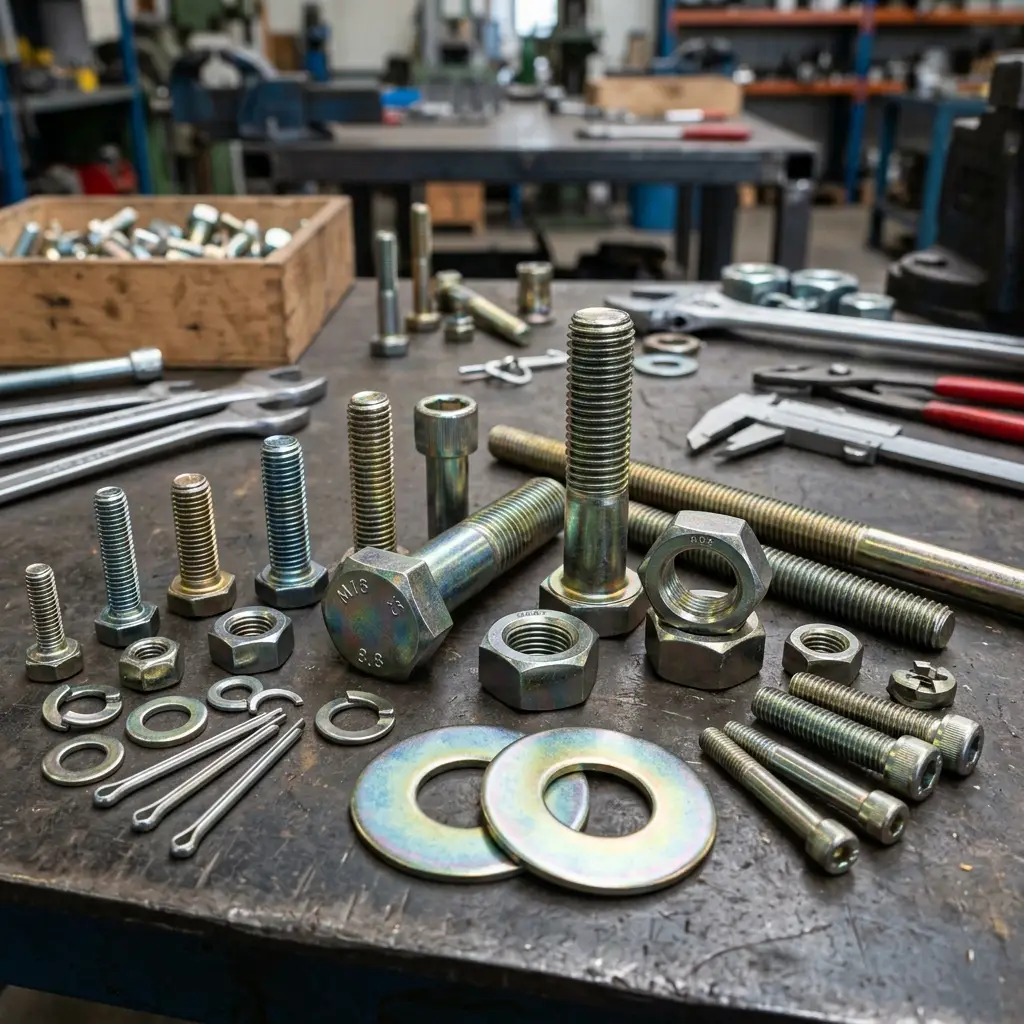
When European automotive OEMs began demanding 500+ hours of salt spray performance from underbody fasteners in the mid-1990s, plain zinc plating simply could not meet the requirement. The industry needed a step-change in corrosion performance without the cost and complexity of stainless steel or expensive alloys. Zinc-nickel alloy electroplating was the answer — and it remains the dominant corrosion protection system for automotive and heavy engineering fasteners to this day.
This guide covers zinc-nickel alloy plating from first principles: why alloying nickel into zinc dramatically boosts corrosion resistance, how to specify the right nickel content for your application, and what to expect from an OEM-grade zinc-nickel process.
Why Zinc-Nickel? The Metallurgy of Corrosion Resistance
Plain zinc provides “sacrificial” corrosion protection — zinc is anodic to steel, so it preferentially oxidises and protects the steel substrate underneath. This works well for moderate environments. The problem is that pure zinc corrodes relatively quickly at a rate of 1–5 µm per year in typical outdoor exposure.
When nickel is alloyed into the zinc deposit at 12–15% by weight, something remarkable happens at the microstructural level. The dominant phase in the alloy shifts from pure η-zinc to the γ-phase (Ni₅Zn₂₁) intermetallic compound. This γ-phase has two critical advantages:
- It corrodes dramatically more slowly than pure zinc — the corrosion rate of the γ-phase in neutral salt spray is approximately 5× lower than pure zinc
- It remains anodic to steel — so the sacrificial protection mechanism is preserved even after the slower corrosion progresses
The result: zinc-nickel at 8–12 µm thickness, properly passivated, routinely achieves 720–1,000 hours neutral salt spray performance versus 200–300 hours for equivalent zinc thickness. This is the step-change OEMs needed.
Nickel Content: The Most Critical Parameter
The corrosion performance of zinc-nickel is extremely sensitive to the nickel content of the deposit. This is the most important thing to understand about this process.
| Nickel Content (wt%) | Dominant Phase | Corrosion Performance |
|---|---|---|
| < 8% | η-Zn + δ-phase mixture | Moderate — similar to zinc |
| 12–15% (optimal) | γ-phase (Ni₅Zn₂₁) | Excellent — 5–7× pure zinc |
| > 18% | δ-phase + ε-phase | Reduced — loses OEM approval |
The target window of 12–15% nickel is narrow and must be controlled precisely. Both falling below 10% and exceeding 17% produces deposits that look identical visually but fail dramatically earlier in salt spray testing. This is why XRF (X-ray fluorescence) alloy composition analysis is mandatory in any credible zinc-nickel plating operation.
How OEMs Specify This
Major automotive OEM specifications for zinc-nickel include:
| OEM/Standard | Specification | Nickel Range | Min Salt Spray (Red Rust) |
|---|---|---|---|
| Volkswagen Group | VW 13750 | 12–16% Ni | 720 hours |
| Mercedes-Benz | MB LN 9439 | 12–16% Ni | 720 hours |
| General Motors | GMW 3044 | 12–16% Ni | 500 hours |
| Stellantis | SATS 5.2.8.2 | 12–15% Ni | 720 hours |
| ISO Standard | ISO 12683 | 10–15% Ni | Per grade |
If you are supplying to an automotive Tier 1 or OEM, you should obtain the specific plating specification from your customer’s PPAP package and verify that your plater can demonstrate XRF composition control within the specified range on a per-batch basis.
Zinc-Nickel Bath Chemistry
Zinc-nickel is plated from one of two electrolyte types:
Alkaline Zinc-Nickel Bath
| Component | Range | Function |
|---|---|---|
| Zinc (as ZnO) | 6–10 g/L | Zinc ion source |
| Nickel (as NiSO₄ or NiCl₂) | 1.5–3.5 g/L | Nickel ion source |
| Potassium Hydroxide (KOH) | 100–140 g/L | Conductivity and complexing |
| Organic Complexing Agent | 30–50 mL/L | Controls Ni/Zn co-deposition ratio |
| Brighteners | 3–6 mL/L | Grain refinement, surface appearance |
The alkaline bath is preferred for complex geometries because it inherits the superior throwing power of alkaline zinc. The organic complexing agent is the critical differentiator — it controls the rate at which nickel is incorporated relative to zinc, maintaining the 12–15% nickel window across the full current density range of the part.
Acid Zinc-Nickel Bath
Used for barrel plating of simpler geometries where throughput is critical. Provides slightly brighter deposits but with worse throwing power than the alkaline variant. Less commonly specified for complex automotive parts.
Post-Plating Treatments
Passivation
Zinc-nickel requires a passivation treatment formulated specifically for zinc-nickel — standard zinc passivation chemistry does not work properly on zinc-nickel alloys because the γ-phase has different reactivity.
| Passivation Type | Salt Spray to White Rust | Salt Spray to Red Rust | Colour |
|---|---|---|---|
| Clear Trivalent | 120–200 hours | 500–600 hours | Clear/slight blue |
| Black Trivalent | 200–300 hours | 720–800 hours | Matte black |
| Thick Film Trivalent | 400–500 hours | 900–1,000+ hours | Iridescent |
All passivation options at Platinex are trivalent (Cr³⁺) only — fully RoHS and ELV Directive compliant.
Hydrogen Embrittlement Relief
Like alkaline zinc, the alkaline zinc-nickel process generates significant hydrogen at the cathode. For high-strength steel fasteners (Grade 10.9 and above), post-plate baking at 190–220°C for 4–24 hours (per ASTM F519 or customer specification) is mandatory before passivation to prevent delayed hydrogen embrittlement fracture.
Applications by Sector
Automotive Underbody: Wheel bolts, brake caliper bolts, suspension fasteners, subframe hardware. These parts see road salt, moisture, and temperature cycling — zinc-nickel’s combination of sacrificial protection and slow corrosion rate is ideal.
Engine Bay Fasteners: Heat resistance is an advantage of zinc-nickel versus plain zinc — the γ-phase is thermally stable to ~200°C, whereas plain zinc passivation breaks down around 120°C.
Brake System Components: Caliper guide pins, brake pad hardware, anchor brackets — long-life corrosion protection without compromise on thread dimensions.
Agricultural Equipment: Implements and fasteners exposed to fertiliser, soil acids, and weather. Zinc-nickel provides the corrosion life needed for equipment that may not receive maintenance for months.
Rail and Heavy Transport: Chassis hardware for trucks, trailers, and railway rolling stock where MIL-grade corrosion resistance is required at a commercial price point.
Zinc-Nickel vs Plain Zinc: Cost Justification
Zinc-nickel costs approximately 40–70% more than equivalent-thickness zinc plating, primarily due to:
- Nickel metal cost in the bath
- More complex bath chemistry and tighter control requirements
- XRF analysis per batch (mandatory for OEM compliance)
- Higher additive consumption
The justification is straightforward: if a plain zinc part fails in the field at 3 years, requiring a warranty repair or recall, the cost vastly exceeds the incremental plating cost differential. For automotive OEM and safety-critical applications, zinc-nickel is not a premium option — it is the correct engineering specification.
Frequently Asked Questions
Does zinc-nickel plate look different from plain zinc? Freshly plated zinc-nickel with a clear trivalent passivation looks very similar to clear-passivated zinc — slightly more silver/grey and less iridescent. Black trivalent passivation produces a deeper, more uniform black than black zinc passivation. XRF analysis, not visual inspection, is required to confirm nickel content.
Can zinc-nickel be plated in barrel process? Yes. Barrel plating is the standard method for fasteners and small hardware. Rack plating is used for larger or more complex components where geometry requires the superior throwing power of rack-mounted parts.
Is zinc-nickel RoHS compliant? The alloy deposit itself is compliant. What matters is the passivation: trivalent (Cr³⁺) passivation is fully RoHS compliant. Hexavalent chromium (Cr⁶⁺) passivation, which is not used in any modern compliant shop, is prohibited.
What nickel content should I specify on my drawing? Specify “Zinc-Nickel Alloy Plating, 12–15% Ni by weight, minimum 8 µm, trivalent passivation, 720 hours neutral salt spray to first signs of red corrosion products per ASTM B117.” This callout covers the critical parameters and is recognised by ISO 12683.
Can I use zinc-nickel on aluminium? Not directly — the alkaline bath attacks aluminium. For aluminium substrates requiring enhanced corrosion protection, anodising or electroless nickel are more appropriate choices.
Supplying to automotive OEMs and need zinc-nickel plating with PPAP-ready documentation? Contact Platinex Industries in Nashik — we serve Tier 1 and Tier 2 automotive suppliers across Maharashtra.