
Electroless Nickel Plating (ENP): The Complete Technical Guide
Understand the autocatalytic chemistry of Electroless Nickel Plating. Learn the differences between Low, Mid, and High-Phosphorus ENP, and why its perfect throwing power makes it essential for complex engineering parts.
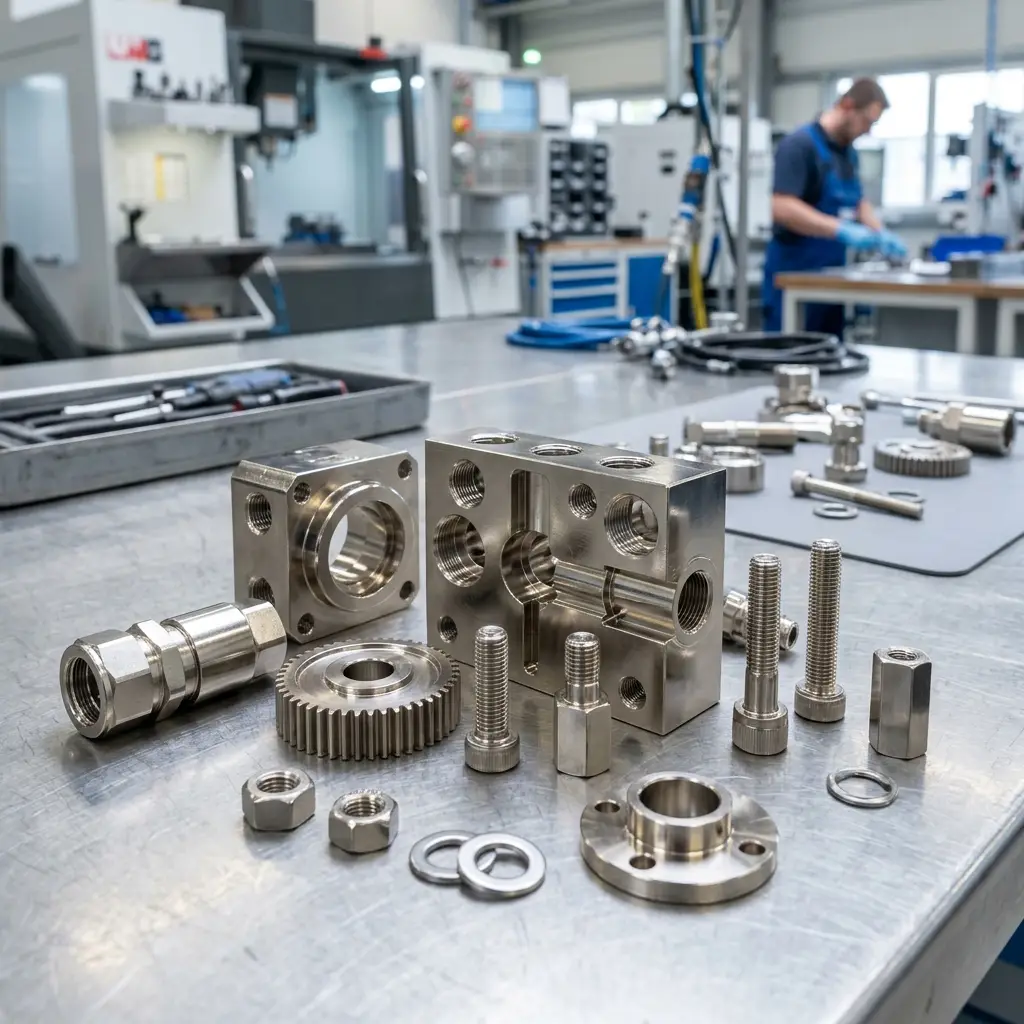
If you have a complex machined part with deep blind holes, internal threads, and sharp external corners, and you need exactly 25 µm of corrosion protection across every square millimeter of its surface, standard electroplating will fail you.
Electricity is lazy. It rushes to outer edges and ignores deep recesses (poor throwing power). To achieve perfectly uniform coating thickness regardless of part geometry, you must remove electricity from the equation entirely.
This is the domain of Electroless Nickel Plating (ENP).
What is Electroless Nickel Plating?
Unlike electroplating, which uses an external electrical current to reduce metal ions onto the part, electroless plating relies on an autocatalytic chemical reduction.
In the ENP bath, a chemical reducing agent (almost exclusively sodium hypophosphite) provides the electrons necessary to reduce nickel ions into metallic nickel. The magic of the process is that this reaction only occurs on a catalytic surface. Once the initial layer of nickel is deposited onto the substrate (steel, aluminum, or copper), the nickel itself acts as the catalyst, allowing the reaction to continue indefinitely.
The Autocatalytic Advantage: Perfect Uniformity
Because the reaction is purely chemical and driven by the bath’s temperature and concentration—not by an electrical field—the nickel deposits at the exact same rate on every surface exposed to the solution.
- The outside edge receives 25 µm.
- The inside of a blind hole receives 25 µm.
- The root of an internal thread receives 25 µm.
This perfect uniformity means ENP parts rarely require post-plate machining or grinding to maintain tight dimensional tolerances.
The Role of Phosphorus
Because sodium hypophosphite is used as the reducing agent, phosphorus is co-deposited into the nickel matrix. ENP is actually a Nickel-Phosphorus alloy, not pure nickel.
The percentage of phosphorus in the deposit radically alters the physical and chemical properties of the coating. ENP baths are categorized by their phosphorus content:
1. Low Phosphorus (1% - 4% P)
- Structure: Microcrystalline.
- Hardness: Very high as-plated (up to 700 HV).
- Key Benefit: Excellent wear resistance and solderability. Used heavily in electronics and high-wear mechanical parts.
- Drawback: Lowest corrosion resistance of the ENP family.
2. Medium Phosphorus (5% - 9% P)
- Structure: Mixed microcrystalline and amorphous.
- Hardness: Moderate as-plated (~500 HV).
- Key Benefit: The “workhorse” of ENP. It offers the best balance of fast plating speed, moderate corrosion resistance, and good wear properties.
- Applications: General industrial, machinery, and automotive components.
3. High Phosphorus (10% - 14% P)
- Structure: Fully amorphous (glass-like, no grain boundaries).
- Hardness: Lower as-plated (~400 HV).
- Key Benefit: Ultimate corrosion and chemical resistance. Because it lacks grain boundaries (which are pathways for corrosion), High-Phos ENP is essentially impenetrable to most harsh chemicals. It is also non-magnetic.
- Applications: Oil & gas valves, chemical processing equipment, aerospace components, and marine environments.
Hardness and Heat Treatment
While High-Phosphorus ENP is relatively soft as-plated (~400 HV), it possesses a unique metallurgical trait: it can be precipitation hardened.
If an ENP-plated part is baked in an oven at roughly 400°C for 1 to 2 hours, the nickel-phosphorus matrix crystallizes, forming hard nickel-phosphide (Ni₃P) particles. This heat treatment skyrockets the hardness to 1,000 - 1,100 HV—making it equivalent to, or harder than, Hard Chrome plating.
Note: Heating High-Phos ENP to 400°C will drastically reduce its corrosion resistance by creating micro-cracks and grain boundaries. You must choose whether the application prioritizes extreme wear resistance (heat treated) or extreme corrosion resistance (as-plated).
Substrate Preparation and Limitations
ENP can be applied to almost any engineering metal, but the pre-treatment is critical.
- Steel: Plates directly after standard alkaline cleaning and acid pickling.
- Aluminum: Aluminum is highly reactive and will poison the ENP bath. It requires a strict Zincate double-dip process before it can enter the ENP tank.
- Copper/Brass: Copper is not a natural catalyst for the ENP reaction. To initiate plating, a copper part must either receive a brief cathodic electrical “jolt” when it enters the bath, or it must be struck with an electrolytic nickel layer first.
Bath Control Challenges
ENP is one of the most difficult plating baths to operate. As the chemical reaction proceeds, orthophosphite byproducts build up, pH drops, and the bath chemistry changes. The bath requires constant, real-time chemical replenishment and has a finite lifespan (measured in “metal turnovers”) before it must be dumped and rebuilt entirely. This chemical consumption makes ENP significantly more expensive than electrolytic nickel or zinc plating.
When to Specify ENP
Specify Electroless Nickel when:
- The part has complex geometry (deep holes, internal threads) requiring perfectly uniform coating thickness.
- The application demands extreme chemical or corrosion resistance (High-Phos).
- The part requires the hardness of hard chrome, but the geometry makes hard chrome impossible to apply evenly.
- You need to salvage an undersized, precision-machined part by adding an exact, uniform thickness of metal.
Platinex Industries specializes in precision Electroless Nickel Plating for automotive, aerospace, and general engineering applications. Contact us to discuss the correct phosphorus alloy for your specific environment.