
Electroless vs Electrolytic Nickel Plating: Choosing the Right Finish
Understand the critical differences between Electroless Nickel (ENP) and Electrolytic Nickel plating, including thickness uniformity, hardness, and corrosion resistance.
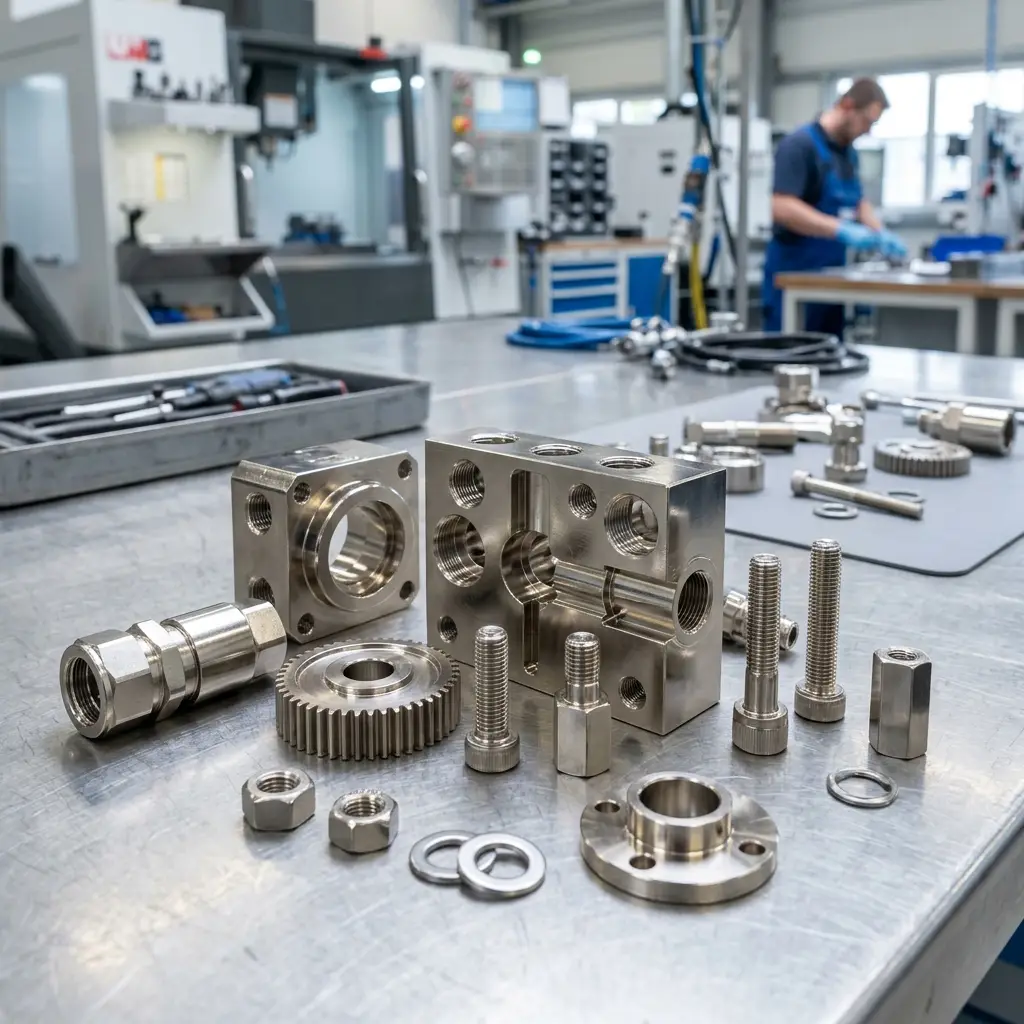
When specifying a nickel finish for industrial components, engineers often face a critical choice: Electroless Nickel Plating (ENP) or Electrolytic Nickel Plating. While both provide a nickel-based surface, the deposition methods, physical properties, and performance characteristics differ significantly.
In this guide, we break down the science behind both methods to help you choose the optimal finish for your application.
1. The Deposition Process: Electric Current vs. Chemical Reaction
Electrolytic Nickel Plating (Electroplating)
Electrolytic nickel relies on Faraday’s Law. An electric current is passed through a nickel-salt solution (electrolyte). Nickel ions from the anode are reduced at the cathode (your part), forming a metallic coating.
- Key Characteristic: The coating thickness is directly proportional to the current density. This leads to “high-current density” areas (edges and corners) receiving more plating than “low-current density” areas (recesses and holes).
Electroless Nickel Plating (Autocatalytic)
Electroless nickel is a purely chemical process. Instead of an external power source, it uses a reducing agent (typically sodium hypophosphite) to deposit a nickel-phosphorus alloy onto the substrate.
- Key Characteristic: Because it doesn’t rely on current flow, the deposition is perfectly uniform across all surfaces, regardless of the part’s geometry.
2. Comparison Table: Physical Properties
| Feature | Electrolytic Nickel | Electroless Nickel (ENP) |
|---|---|---|
| Thickness Uniformity | Non-uniform (Edge buildup) | Perfectly Uniform |
| Hardness (As Plated) | 150 - 400 HV | 450 - 600 HV |
| Hardness (Heat Treated) | No change | Up to 1000 HV (Rockwell C 68) |
| Corrosion Resistance | Good | Superior (especially High-Phos) |
| Ductility | High | Low (Brittle) |
| Solderability | Excellent | Good |
| Typical Alloy | Pure Nickel (99%+) | Nickel-Phosphorus (2-14% P) |
3. When to Choose Electroless Nickel (ENP)
Electroless Nickel is the “engineering” finish. You should specify ENP when:
- Complex Geometries: If your part has deep blind holes, internal threads, or complex internal channels, ENP is the only way to ensure 100% coverage with zero dimensional variance.
- Maximum Wear Resistance: Due to its phosphorus content, ENP is significantly harder than electrolytic nickel. When heat-treated, it approaches the hardness of hard chrome.
- Severe Corrosion Environments: High-phosphorus ENP (10-14% P) is amorphous (non-crystalline), making it highly resistant to chemical attack and salt spray.
- Salvage & Buildup: Because of its uniform growth, ENP is often used to “save” undersized parts by adding precise layers of material back onto critical tolerances.
4. When to Choose Electrolytic Nickel
Electrolytic nickel remains a staple in manufacturing for specific reasons:
- Cost Efficiency: For simple shapes and high-volume runs, electrolytic plating is faster and significantly cheaper than electroless processes.
- Bright Decorative Finishes: If the primary goal is a “mirror-like” aesthetic (often followed by chrome), bright electrolytic nickel is the industry standard.
- Ductility: If the component needs to be bent or crimped after plating, pure electrolytic nickel is less likely to crack or flake compared to the more brittle ENP alloy.
- Thickness Requirements: Electrolytic plating can build up very thick layers (250μm+) much faster than the slow, controlled rate of electroless baths.
5. Conclusion: The Decision Matrix
- Choose ENP for: Precision valves, internal pump components, aerospace fasteners, and high-wear automotive gears.
- Choose Electrolytic for: Decorative trim, base layers for chrome, high-volume flat stampings, and simple electrical busbars.
At Platinex Industries, we operate both fully-automated electrolytic lines and precision electroless nickel baths. Our engineering lab can help you determine the exact phosphorus content and heat-treatment cycle required for your specific application.
Need a technical consultation? Contact our engineering team today.