
Electropolishing Stainless Steel: Mirror Finish Through Chemistry
Learn how electropolishing reverses the electroplating process to remove microscopic peaks from stainless steel, resulting in a sterile, ultra-smooth, highly corrosion-resistant surface.
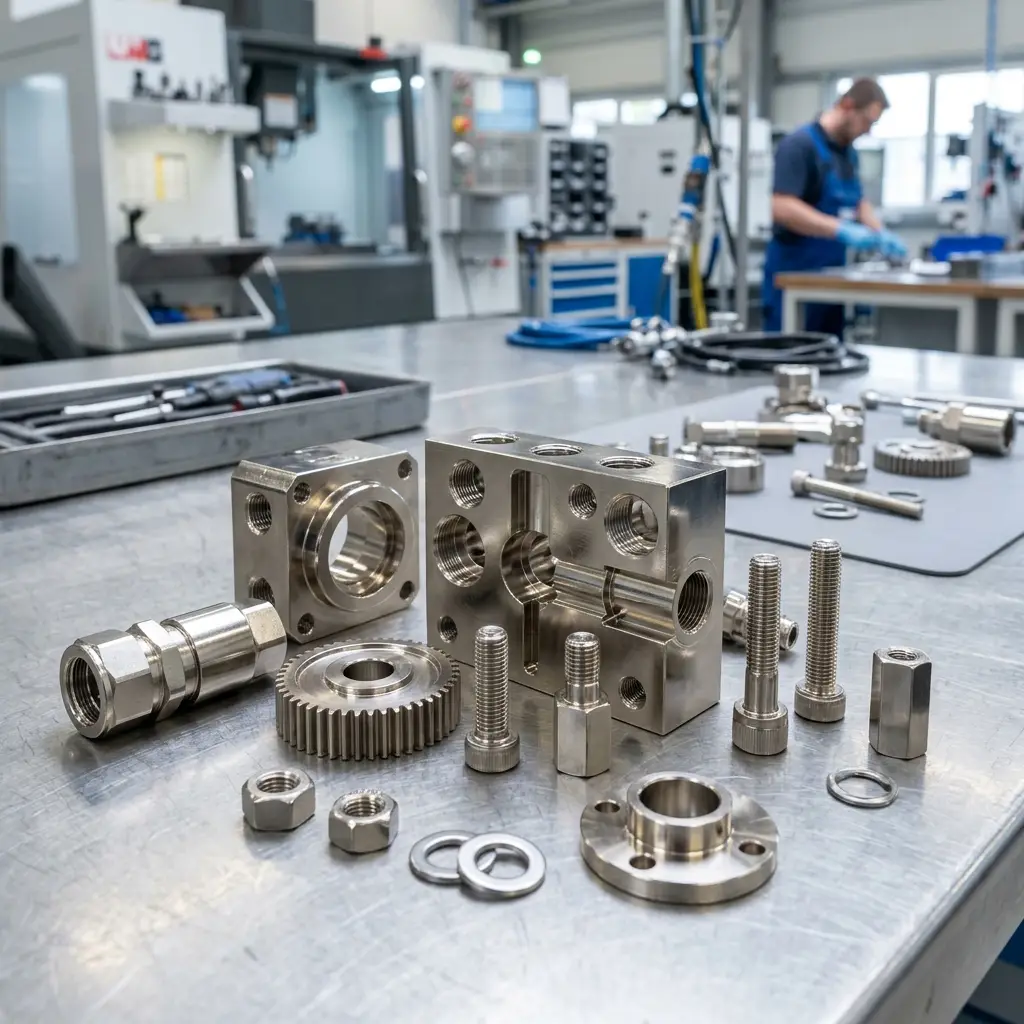
Stainless steel is inherently corrosion-resistant due to its chromium content, which forms a passive chromium-oxide layer. However, raw stainless steel straight from a mill, or a part that has just been machined or welded, has a microscopically rough surface fraught with embedded iron particles, heat tint, and torn metal.
To turn raw stainless steel into the ultra-hygienic, mirror-bright material required for surgical instruments, pharmaceutical pipes, and semiconductor vacuum chambers, the industry relies on Electropolishing.
Electropolishing is often described as “reverse electroplating.” Instead of adding metal to the part, the process uses electricity and chemistry to meticulously strip metal away, focusing entirely on the microscopic high points.
How Electropolishing Works
In standard electroplating, the part is the cathode (negative), and metal ions are deposited onto it. In electropolishing, the part is connected as the anode (positive).
- The Bath: The stainless steel part is submerged in a highly concentrated, highly viscous electrolyte bath—typically a dense mixture of sulfuric acid and phosphoric acid, heated to 60°\textC - 80°\textC.
- The Current: A very high direct current (DC) is applied.
- The Viscous Film: As the current flows, the acid reacts with the metal surface, creating a thick, highly viscous film of dissolved metal salts immediately adjacent to the part surface.
- Micro-Leveling: This viscous film is thicker in the microscopic “valleys” of the metal and thinner over the microscopic “peaks.” Because the film acts as an electrical resistor, current concentrates heavily on the exposed peaks. The peaks dissolve rapidly, while the valleys are protected by the thick film.
The result? The microscopic jagged edges of the metal are sheared off atom by atom. Over a cycle of 5 to 15 minutes, the surface becomes incredibly smooth, leveled, and highly reflective.
The Benefits of Electropolishing
While the brilliant, mirror-like aesthetics are the most obvious result, the engineering benefits of electropolishing are profound.
1. Superior Corrosion Resistance (Super-Passivation)
Stainless steel relies on its chromium-to-iron ratio to resist rust. Machining and forming leave free iron particles embedded in the surface, which will quickly form rust spots. Electropolishing preferentially dissolves iron and nickel faster than it dissolves chromium. When the part leaves the bath, the remaining surface is massively enriched in chromium. This creates a chromium-oxide passive layer that is significantly thicker and more robust than one achieved by standard chemical passivation (nitric or citric acid dips).
2. Pathogen and Biofilm Resistance
In the medical, pharmaceutical, and food-processing industries, bacteria are the enemy. Bacteria cling to the microscopic jagged edges and valleys of mechanically polished steel. Because electropolishing removes these micro-crevices, the resulting surface is practically frictionless at the microscopic level. Biofilms cannot anchor themselves, and the surface becomes vastly easier to sterilize.
3. De-Burring without Tumbling
For small, delicate, or complex parts (like medical stents or fine surgical needles), mechanical deburring (tumbling in abrasive media) would destroy the part. Because electropolishing naturally attacks high-current-density areas (edges and points) first, it effortlessly dissolves microscopic burrs, leaving smooth, radiused edges without any physical force.
4. Stress Relief
Mechanical polishing (grinding, buffing) smears the surface metal, creating a highly stressed, amorphous layer known as the Beilby layer. Electropolishing dissolves this stressed outer skin entirely, revealing the pure, unstressed crystalline structure of the base metal.
Dimensional Changes and Limitations
Unlike mechanical buffing, which primarily moves metal around, electropolishing permanently removes metal.
- Dimensional Loss: A standard electropolishing cycle removes between 10 \text µm and 25 \text µm (0.0004” to 0.001”) of material per surface. Engineers must design tight-tolerance parts slightly oversize to account for this predictable loss.
- It Cannot Fix Deep Scratches: Electropolishing removes micro-roughness. If a part has deep gouges, heavy machining marks, or deep pits, electropolishing will make those defects bright and shiny, but it will not erase them. Heavy defects must be mechanically removed prior to electropolishing.
- Alloy Dependence: Electropolishing works best on 300-series austenitic stainless steels (304, 316). It works moderately well on 400-series martensitic steels, but the finish will not be as brilliant due to the lower chromium and nickel content.
Electropolishing vs. Chemical Passivation
Do not confuse electropolishing with standard passivation (ASTM A967).
- Chemical Passivation (Nitric/Citric Acid): Removes surface free-iron and promotes the natural chromium oxide layer. It does not alter the surface finish or remove bulk metal.
- Electropolishing: Removes bulk metal, levels the surface, creates a mirror finish, and provides ultimate passivation simultaneously.
For high-purity applications where mechanical polishing falls short, electropolishing is the ultimate finishing step for stainless steel components.